

SAFEcore Edge: Network Edge Security from the Field to HQ
June 10, 2026 | Post Quantum Cryptography, Security
Why Network Edge Security Has Become So Important
As infrastructure becomes increasingly distributed, network edge security and network segmentation has become a critical challenge for organisations operating financial, retail, industrial and national infrastructure.
Today, critical infrastructure stretches across data centres, cloud environments, telecoms networks, remote industrial sites, payment systems, autonomous technologies and edge devices operating far beyond traditional IT environments.
The challenge facing organisations is no longer simply how to secure the core of the network. It is how to secure every connection across the entire operational landscape without sacrificing speed, resilience or control.
That is why Sitehop has launched SAFEcore Edge, the world’s smallest hardware-enforced post-quantum encryption device for network edge security and network segmentation.
But SAFEcore Edge is not just another security appliance. It is part of a much bigger platform story that reflects how modern industries operate today.
At the centre of that story sits the telecoms fabric where Sitehop’s SAFEcore is located. Around it are the industries society depends on every day: financial services, retail, operational technology and critical national infrastructure. And it’s in the field of these sectors where SAFEcore Edge protects data-in-motion and the network at the edge.
From core to edge, we help these industries build a connected ecosystem where secure, low-latency, PQC ready communications are possible.
A Platform Built for the Real World
Modern networks do not operate in silos.
Banks rely on telecoms infrastructure to connect trading platforms, payment systems, branches and cloud environments. Retailers depend on secure connectivity between stores, payment operations, logistics and digital commerce. Industrial operators need resilient communications between control systems, substations, plants and enterprise environments.
Everything is connected. That is why the SAFE Series Platform has been designed as a true core-to-edge architecture.
At the centre is the secure telecoms fabric. This provides the encrypted transport layer that connects all domains, locations and operational environments through carrier networks, cloud on-ramps and segregated encrypted paths.
On top of that fabric sit the vertical industries that depend on it, such as:
- Financial services
- Retail
- OT and critical infrastructure
Each sector has different operational challenges, regulatory pressures and performance requirements. But they all share the same need for ultra-secure, resilient, high-performance communications. SAFEcore secures central operations and data centre environments. SAFEcore Edge extends that protection directly into remote and operational locations where traditional security infrastructure often cannot reach. SAFEnms provides centralised visibility, orchestration and policy control across the entire encrypted estate.
Together, they create a platform that protects organisations from core to edge.
Why the Edge Has Become So Important
The edge is where modern operations increasingly happen.
It is where financial transactions are processed in real time. It is where retailers connect stores, kiosks and payment systems. It is where industrial operators manage substations, SCADA systems and remote assets. It is where autonomous systems make live operational decisions. And increasingly, it is where cyber risk exists.
Traditional security models struggle in these environments because they were designed for static, centralised infrastructure. They often introduce latency, complexity and operational overhead that modern industries simply cannot afford.
SAFEcore Edge changes that. Small enough to fit in the palm of a hand, it delivers hardware-enforced post-quantum encryption directly at the edge of the network.
That means organisations can secure:
- Branch banking infrastructure, ATMs and exchanges
- Retail stores and payment environments
- Remote operational sites
- SCADA and PLC environments
- Drones and autonomous systems
- Government and defence communications
- Distributed industrial infrastructure
All without compromising performance.
Security Without the Trade-Off
For years, organisations have had to choose between strong security and operational performance. Sitehop believes that trade-off should not exist.
SAFEcore Edge delivers up to 1,000 times lower latency than software-only encryption solutions, making it possible to secure highly sensitive environments without slowing critical operations. That matters enormously in sectors where milliseconds can have real operational and financial consequences.
In financial services, it enables secure, ultra-low-latency trading and payments infrastructure.
In retail, it protects payment systems and customer data across distributed environments while simplifying operations.
In OT and critical infrastructure, it secures operational networks while supporting resilient, always-on environments.
This is security designed to operate at the speed of modern infrastructure.
Built for Critical Infrastructure
SAFEcore Edge was designed in Sheffield and is manufactured in the North of England.
That is important because resilience is no longer just about cybersecurity. It is also about trusted supply chains, sovereign capability and operational assurance.
The industries SAFEcore Edge is designed to protect are critical to daily life. Energy, finance, communications, retail operations, transportation and national infrastructure all depend on secure and resilient connectivity.
Melissa Chambers, CEO of Sitehop, explains:
“As cyber threats escalate, securing the communications that underpin our critical infrastructure, financial system and government networks has never been more important.
SAFEcore Edge is British-engineered sovereign technology that brings post-quantum encryption to every point on the network, however remote, protecting the institutions and systems that people and businesses depend on every day.”
The Bigger Shift Taking Place
The launch of SAFEcore Edge reflects a much larger shift happening across technology and infrastructure.
Networks are becoming more distributed. Industries are becoming more connected. Operational environments are becoming more autonomous. At the same time, the threat landscape is accelerating through AI-driven attacks and the future impact of quantum computing.
The organisations that succeed in this new environment will be the ones that can secure every part of their infrastructure without adding friction or complexity.
That requires a different approach to cybersecurity. Not isolated point products. Not disconnected security layers. But a unified platform that delivers secure, segregated, ultra-low-latency communications from core to edge.
That is the SAFE Series Platform. And SAFEcore Edge is the next step in bringing that vision to life. Because resilience today is not just about protecting networks.
It is about protecting the systems the world depends on every day.
Request a demo if you’d like to see our platform in action.
Stay in touch with Sitehop’s latest thinking, subscribe to our PQC Bulletin.
Or call us: +44 (0)114 478 2366
Sitehop.
Sitehop. Engineered for resilience. Built for the life.

Why Banks and Financial Services Networks Need Hardware-Accelerated Data Encryption
April 21, 2026 | Post Quantum Cryptography
There was a time when encryption in financial services sat quietly in the background, an essential safeguard, but not something that shaped the architecture of the network itself. That time has passed – Q-day is inevitable.
Today, encryption is everywhere. It protects transactions, secures internal communications, and underpins trust across an increasingly complex financial ecosystem. But as encryption has expanded, something subtle, and critical, has happened: it has moved from being a protective control to becoming part of the data plane itself.
And yet, much of it is still running on foundations never designed for that role.
This is where the conversation changes.
Why Software-Only Encryption No Longer Fits Financial Services Networks
Software-Only Encryption Was Never Designed as a Primary Enforcement Layer
Most encryption technologies deployed across financial services were built with a different assumption, that encryption would be applied selectively, not universally.
They were designed for moderate traffic volumes, intermittent use, and spare CPU capacity to absorb overhead.
But modern financial environments don’t operate like that anymore.
Encryption is now always on, high volume, and mission-critical. Without much fanfare, encryption has become embedded in the core of the network, handling vast volumes of sensitive data in real time. The challenge is that software-based approaches were never intended to operate as the primary enforcement layer at this scale.
How Financial Services Networks Have Fundamentally Changed
Financial services networks have evolved rapidly, and not always in ways legacy encryption models can comfortably support.
- Explosive growth in encrypted east–west traffic between trading systems, payment rails, and data centres
- Latency-sensitive workloads where predictability matters as much as speed
- Highly meshed architectures spanning on-prem, cloud, and hybrid environments
- Increasing regulatory scrutiny under frameworks like DORA and NIS2
In this environment, encryption is no longer a layer you can simply add. It is woven directly into operational flow.
The Architectural Mismatch This Creates
This shift has exposed a fundamental tension. Software-only encryption competes for the same resources as the applications it is meant to protect.
It draws from shared CPU capacity, meaning performance becomes dependent on workload conditions. Under pressure, whether from peak trading activity, payment spikes, or failover scenarios, encryption behaviour can shift in ways that are difficult to predict or test.
This creates a fragile balance between security, performance, and resilience, one that financial institutions cannot afford to leave to chance. The encryption of financial data cannot become the bottleneck.
Why This Matters Now
The urgency is immediate rather than theoretical.
Regulators increasingly expect firms to demonstrate that security controls behave consistently under stress. Encryption failures, or even performance degradation, can directly affect service availability, customer outcomes, and regulatory standing.
At the same time, preparation for post-quantum cryptography is accelerating. This will significantly increase cryptographic workloads, placing even greater strain on already stretched architectures.
Financial institutions are now being forced to rethink not just what encryption they use, but where and how it is enforced.
Core Encryption Technologies and Practices in Financial Services
Encryption Algorithms Used in Banking
Two core technologies underpin most encryption strategies in financial services.
- Advanced Encryption Standard (AES), widely adopted for protecting sensitive data both at rest and in transit, delivering strong security but becoming computationally demanding at scale when handled purely in software
- RSA Encryption, essential for secure key exchange and digital signatures, forming the backbone of public key infrastructure, but increasingly impactful in terms of performance in highly connected environments
Key Management Practices
Encryption strength is inseparable from how keys are managed. As environments scale, this becomes an operational challenge rather than a purely technical one.
Secure key generation, storage, and distribution must be tightly controlled. Regular rotation is essential to reduce exposure but introduces complexity when thousands of encrypted connections are in play.
Access must also be carefully governed. Multi-factor authentication, role-based permissions, and strict separation of duties are all necessary to maintain auditability and trust.
As networks grow, key management quietly becomes one of the most demanding aspects of encryption strategy.
Endpoint and Database Encryption
Endpoint and database encryption remain critical layers of defence, protecting sensitive data where it resides.
- Securing endpoints such as ATMs, mobile banking applications, and employee devices
- Encrypting databases, including highly sensitive fields like account and card information
However, these protections do not extend into the network itself. Data in motion, constantly moving between systems, remains exposed to the limitations of the underlying encryption architecture.
Encryption for Network Transmission
Encryption in transit is now a standard expectation across financial services.
Transport Layer Security protects customer-facing channels and digital services. IPsec secures private networks, including SD-WAN and SASE architectures. Cloud encryption safeguards data across hybrid and multi-cloud environments.
These technologies are indispensable. Yet when implemented purely in software, they inherit the same challenges of scalability, contention, and unpredictability.
Regulatory and Compliance Considerations
Compliance Requirements for Financial Institutions
Encryption is firmly embedded within regulatory expectations.
Frameworks such as PCI DSS, GDPR, DORA, and NIS2 all reinforce its role as a baseline requirement. But expectations are evolving. Regulators are increasingly concerned with how encryption performs under real-world conditions, not just whether it is present.
Unpredictable behaviour, especially under stress, is no longer acceptable.
Security Frameworks and Standards
Financial institutions must align with established standards while preparing for future change.
- NIST-approved cryptographic algorithms provide a foundation for trusted security
- ISO/IEC 27001 offers guidance on implementing and managing encryption controls
- Cryptographic agility is becoming essential, enabling organisations to adapt as threats and standards evolve
This shift places pressure on existing architectures to be both robust and flexible.
Protecting Customer Personally Identifiable Information (PII)
Protecting PII is one of the most visible and high-stakes applications of encryption.
Sensitive data must be secured to prevent fraud, identity theft, and unauthorised disclosure. It must also be transmitted safely across increasingly complex internal and external networks.
When encryption enforcement falters, even momentarily, the consequences can be immediate, affecting both customer trust and regulatory compliance.
Hardware-Accelerated Encryption as a Foundational Layer for Financial Services
Limitations of Software-Only Encryption Approaches
Software-only encryption was never designed to operate as the primary enforcement layer for financial services networks.
As traffic volumes increase, performance becomes variable. Latency and throughput can degrade under load, sometimes in subtle ways that only emerge during critical moments.
This lack of determinism makes it difficult to test, assure, and confidently demonstrate compliance. Over time, it creates friction between security requirements and operational realities.
Benefits of Hardware-Accelerated Encryption
Hardware-accelerated encryption addresses these challenges by shifting enforcement into a dedicated, purpose-built layer.
- Line-rate encryption and decryption, even under high-volume conditions
- Consistent, deterministic latency regardless of workload
- Support for real-time applications such as payments processing and trading systems
By separating encryption from general-purpose compute, hardware reduces contention and stabilises performance.
It also enhances security. Removing cryptographic enforcement from software stacks reduces the attack surface and strengthens separation between data, control, and management planes.
Looking forward, hardware-based approaches enable smoother adoption of new cryptographic standards, including post-quantum encryption, without requiring fundamental architectural change.
Integration with Software-Based Security Controls
This evolution is not about replacing software, but about redefining its role.
Software continues to handle policy, orchestration, visibility, and monitoring. Hardware provides a stable and predictable enforcement layer beneath it.
Together, they create a more balanced and resilient architecture, one that is easier to manage, test, and trust.
Use Cases in Banking and Financial Services
Hardware-accelerated encryption is already being applied across a range of critical financial services environments.
- Securing high-throughput inter-data-centre traffic without introducing latency risk
- Protecting payment networks and trading platforms where timing is critical
- Supporting private WANs and cross-border operations at scale
- Enabling encryption upgrades driven by regulation without disruptive redesign
Each use case reflects the same underlying need, security that performs consistently under pressure.
Conclusion and Future Outlook
Summary of Key Points
Encryption has become foundational to financial services, underpinning security, resilience, and compliance. Software-based approaches remain essential, but they were never designed to operate as the primary enforcement layer at scale.
Hardware-accelerated encryption provides the missing structural foundation, enabling secure, deterministic, and scalable network performance.
Emerging Trends in Data Encryption for Financial Services
Several trends are shaping the future of encryption in financial services.
- A shift toward deterministic security architectures
- Increasing importance of cryptographic agility
- Preparation for post-quantum cryptography without disrupting existing infrastructure
These trends point toward a more integrated, architecture-driven approach to security.
Final Thoughts
Encryption decisions are increasingly architectural decisions.
Financial institutions need security controls that scale operationally, behave predictably under pressure, and adapt to future demands. Hardware-accelerated encryption enables this shift, strengthening existing controls while providing the stability modern networks require.
Future-proof your encryption.
Discover how Sitehop can help you build secure, deterministic, and ready-for-anything financial networks.
Request a demo if you’d like to see our platform in action.
Or stay in touch with Sitehop’s latest thinking, subscribe to our PQC Bulletin.
Or call us: +44 (0)114 478 2366
Sitehop.
Engineered for speed. Built for the future.

Google Just Set the Clock on Cybersecurity’s Biggest Ever Upgrade
April 1, 2026 | Post Quantum Cryptography
By now, most executives have heard some version of the quantum warning.
Quantum computers are coming. Encryption will break. Q-Day is inevitable.
At this point, it risks sounding like the cybersecurity equivalent of ‘eat your vegetables’: widely accepted, vaguely important, and very easy to ignore.
Google’s recent announcement changes that dynamic.
By setting a 2029 timeline for post-quantum cryptography migration, it has shifted the conversation from abstract theory to something far less comfortable: a deadline.
This is not a prediction of when quantum computers will break encryption. It is more practical, and more urgent. It is a signal that organisations should assume the window to act is closing, and plan accordingly.
From Theory to Timeline
The reason this matters is simple. For years, quantum risk has been discussed as a future possibility. Now it is being framed as a present planning problem.
The drivers are well understood:
- Improvements in quantum hardware, particularly error correction
- Rapid reductions in the estimated cost of breaking RSA
- Increasing confidence that large-scale systems are achievable
At the same time, the threat is already active in a quieter form. Sensitive data is being collected today with the expectation that it can be decrypted later, a tactic known as ‘harvest now, decrypt later’.
Which leads to an uncomfortable but important point:
The breach has, in many cases, already happened.
We are simply waiting for the decryption.
The Part Everyone Is Avoiding
If there is one reason the conversation keeps circling back to theory, it is this: the real problem is inconvenient. It is not about choosing a new algorithm. It is about replacing cryptography everywhere, and ‘everywhere’ is doing a lot of work here.
Cryptography sits inside applications and APIs, devices and firmware, networks and data flows, supply chains and third-party services, and legacy systems that nobody wants to touch.
Most organisations do not have a complete map of where it is used; some would struggle to produce even a partial one. Which makes the idea of a clean, orderly migration somewhat optimistic.
Why Waiting Feels Easier, and Why It Isn’t
There is a natural temptation to delay.
After all: The standards are new; The timelines are uncertain; The problem feels distant.
And, if we are honest, the industry has a long tradition of discussing quantum risk without doing very much about it.
But procrastination is not neutral. It creates two very practical risks:
- More data at risk
Every year adds to the volume of information that could be decrypted later - Less time to fix it properly
Migration windows shrink, increasing the likelihood of rushed, disruptive implementations
Put differently: waiting does not reduce uncertainty. It simply reduces options.
The Legal Grey Area, and Why It Matters
There is a common assumption that quantum risk is too early to carry real liability. That assumption may not hold. Under frameworks such as GDPR, organisations are required to implement ‘appropriate technical and organisational measures’, often interpreted as maintaining ‘state of the art’ security.
In practice, this means:
- Using current, proven protections
- Regularly reviewing and updating controls
- Responding to known, credible threats
‘State of the art’ is not fixed. It evolves.
If post-quantum cryptography is available, standardised, and increasingly adopted, and organisations choose not to act, the question becomes uncomfortable:
Is inaction still defensible?
There is, as yet, no case law defining liability in a post-quantum breach scenario. But that may offer little reassurance. Because the organisations that test that boundary will do so after the breach, not before it.
The Conversation Few Boards Want to Have
There is another, less technical barrier. Many organisations struggle to take this issue to the board in clear terms. Because the honest version sounds like this:
‘At some point in the future, the cryptography that underpins everything we do may stop working.’
That is not an easy message to deliver. Nor is it an easy one for boards to act on.So the issue is often softened:
- Framed as a long-term risk
- Delegated to technical teams
- Or deferred for ‘further monitoring’
But the combination of clearer timelines and increasing industry movement makes that position harder to sustain. This is no longer just a technical issue. It is a governance decision
The Problem Is Not Cryptography, It Is Infrastructure
Much of the current discussion focuses on post-quantum algorithms. This is necessary, but it misses the point.
The real challenge is operational.
Replacing cryptography across global infrastructure is not a patch. It is a transformation. And most organisations are not structured to do it quickly, safely, or at all without significant disruption.
Google’s emphasis on ‘crypto agility’, and its integration of post-quantum standards into platforms such as Android, reflects this reality. Security must be designed to evolve, not replaced wholesale.
This is where the gap lies.
What Organisations Should Actually Do
If the conversation is to move beyond theory, it needs to become practical.
The instinct is often to start with multi-year crypto audits. That instinct is understandable, but increasingly flawed. By the time you have perfectly mapped where cryptography sits, the timeline to safely replace it may already have closed. The priority is not perfect visibility. It is controlled remediation at pace.
Three priorities stand out:
- Move from discovery to action
- Assume RSA and ECC are widely embedded
- Prioritise high-risk, high-value systems first
- Begin upgrading now, not after full audits
This is not about understanding everything. It is about reducing exposure quickly.
- Build the ability to adapt
- Avoid hard-coded cryptography
- Enable updates without replacing entire systems
- Design for flexibility
- Think beyond the algorithm
- Treat cryptography as infrastructure
- Plan for continuous change, not one-off migration
- Focus on deployment, not just selection
None of this is particularly glamorous. But it is where the real work lies.
A More Practical Perspective
At Sitehop, we view the quantum transition less as a cryptographic problem and more as an infrastructure one.
The organisations that succeed will not be those that simply adopt post-quantum algorithms. They will be those that can: Deploy changes at scale; Update security dynamically; Maintain performance and uptime. In short, those that can evolve without disruption.
This requires architectures where cryptographic functions can be updated at line speed across networks, rather than replaced system by system.
The Clock Is Now Visible
Google’s timeline does not guarantee when Q-Day will arrive. But it does something arguably more important: it makes inaction harder to justify.
The industry has moved from ‘Quantum is coming’ to ‘You should already be preparing’
The next phase will be less forgiving. Because this is not just another upgrade cycle. It is a reset of the trust mechanisms that underpin the digital economy.
The longer organisations remain in the realm of theory, the more likely they are to encounter the problem in practice. And by that point, it will no longer be a discussion about timelines. It will be a discussion about accountability.
Request a demo if you’d like to see our platform in action.
Or stay in touch with Sitehop’s latest thinking, subscribe to our PQC Bulletin.
Or call us: +44 (0)114 478 2366
Sitehop.
Engineered for speed. Built for the future.

Harvest Now, Decrypt Later: Why Financial Institutions Cannot Afford to Wait on Post-Quantum Security
March 9, 2026 | Post Quantum Cryptography, Financial Services
Encrypted does not mean safe. Not anymore.
Across global financial markets, vast volumes of encrypted data move every second, transactions, pricing feeds, trading instructions, interbank messages, customer records. It is wrapped in strong cryptography and trusted protocols. It passes audits. It meets today’s standards.
But some of that data is already being copied.
Stored.
And kept for a future moment when it can be decrypted.
This is the reality of harvest now, decrypt later, and for financial institutions, the clock is already ticking.
Understanding ‘Harvest Now, Decrypt Later’ (HNDL)
Definition and Concept
Harvest Now, Decrypt Later (HNDL) is a strategic cyber tactic. Adversaries intercept and store encrypted data today, with the expectation that future advances in cryptanalysis, particularly quantum computing, will allow them to decrypt it.
Nothing breaks immediately. No alarms fire. No ransomware note appears.
Instead, it is a time-shifted breach.
Encryption can appear robust today while already failing long-term confidentiality requirements. Data that must remain secret for 10, 20, or even 30 years may already be compromised in waiting.
For financial institutions, that matters deeply. Transaction histories, structured products, customer records, regulatory archives, trading algorithms, these are not short-lived assets. Their value, and their sensitivity, extends far beyond current infrastructure refresh cycles.
HNDL exploits that gap between system lifetime and data lifetime.
Key Threat Actors and Motivations
This is not opportunistic cybercrime.
HNDL is associated with nation-state actors, advanced persistent threat (APT) groups, and other well-resourced adversaries operating with long-term strategic objectives.
Their motivations are rarely immediate financial theft. Instead, they include:
• Strategic intelligence gathering
• Economic and competitive advantage
• Geopolitical leverage
• Long-term influence over markets and critical infrastructure
Encrypted financial data, transaction flows, liquidity movements, proprietary pricing models, these offer systemic insight. Few sectors concentrate such long-lived, high-value information as densely as banking and capital markets.
Financial institutions are uniquely attractive targets precisely because their data endures.
The Role of Quantum Computing in Harvest Now, Decrypt Later
Quantum computing is the enabling factor behind the HNDL model.
There is broad consensus that cryptographically relevant quantum computers do not exist at scale today. However, credible projections suggest they are plausible within the next 10–15 years.
That uncertainty does not reduce risk, it amplifies it.
Data harvested today can simply wait. The collection phase and the decryption phase are separated by time. Adversaries do not need quantum capability now. They only need storage, patience, and belief in future breakthroughs.
Institutions holding long-lived financial data cannot rely on a ‘wait and see’ approach. By the time quantum decryption becomes feasible, the damage may already be baked in.
For deeper background on evolving standards, see NIST guidance on post-quantum cryptography.
Strategic Risks of Harvest Now, Decrypt Later for Financial Institutions
Vulnerable Data Types and Long-Term Risks
The financial sector retains data longer than most industries, often for regulatory, contractual, or operational reasons.
At risk are:
• Financial transaction records and customer histories
• Trading strategies and proprietary analytics
• Pricing models and algorithmic execution logic
• Interbank communications and market infrastructure traffic
• Encrypted backups and archives retained for decades
Some of this data underpins competitive advantage. Some underpins systemic trust. Some underpins legal compliance.
All of it may outlive today’s cryptographic assumptions.
Exposure Windows and Confidentiality Lifetimes
The window between interception and decryption may span years.
But confidentiality lifetimes often span longer.
Government and industry guidance already assumes that post-quantum migration will take many years. Data encrypted in 2026 may need to remain secure well into the late 2030s and beyond.
The risk emerges when organisations design security around system refresh cycles rather than data value duration.
A trading platform may be replaced in five years.
The transaction data it generates may need to remain confidential for twenty.
HNDL exploits that asymmetry.
Threat Models and Attack Vectors
Harvesting does not require breaking encryption.
It requires access to encrypted traffic, including:
• WAN and inter-data centre links
• Cloud connectivity paths
• East–west traffic within modern financial networks
• Long-haul backbone connections
Even trusted, compliant, and audited encrypted channels can be silently copied. Ciphertext can be stored at scale. Modern storage economics make retention trivial.
The absence of visible compromise does not mean the absence of exposure.
A Known Practice That Is Accelerating
Public reporting and historical disclosures have shown that intelligence agencies and sophisticated threat actors collect and retain large volumes of encrypted communications as part of long-term exploitation strategies.
Security researchers increasingly recognise harvest now, decrypt later as a logical extension of these long-standing practices, one that is accelerating as awareness of quantum computing advances spreads.
The model is simple: collect everything now. Decrypt when ready.
For institutions that assume encrypted equals secure indefinitely, that assumption no longer holds.
Preparing for the HNDL Threat: Post-Quantum Cryptography
Why Post-Quantum Security Is a Board-Level Responsibility
HNDL is not a narrow technical issue.
It is a long-term risk to institutional trust, competitiveness, and resilience.
Boards are accountable not only for today’s performance, but for safeguarding sensitive financial data beyond current leadership and technology cycles. Delayed action increases the likelihood of disruptive, forced migrations later, under regulatory pressure or threat escalation.
Regulatory frameworks such as DORA and NIS2 reinforce expectations around resilience, security by design, and the use of ‘state of the art’ cryptography.
For financial institutions holding long-lived data, the relevant risk window is already open, regardless of the exact timing of Q-day.
Migration Planning and Readiness
Post-quantum transitions will take years, not months.
NIST finalised its first post-quantum cryptography standards in 2024 to allow organisations time to prepare before large-scale decryption becomes feasible.
Preparation requires:
• Identifying systems and network paths with long upgrade cycles
• Prioritising backbone and data-in-motion encryption with extended confidentiality requirements
• Mapping cryptographic dependencies across hybrid and multi-cloud environments
Reactive migration under future pressure will be more expensive, more complex, and more disruptive.
Strategic migration is measured and deliberate.
Building Quantum Resilience
Adopting post-quantum algorithms is necessary, but not sufficient.
True resilience requires:
• Crypto-agile architectures that allow algorithms to evolve in place
• The ability to upgrade without wholesale infrastructure replacement
• Reduced HNDL exposure windows through forward-looking design
• Encryption platforms that maintain performance, determinism, and scalability
In financial markets, security cannot come at the expense of latency predictability or throughput. Protection and performance must coexist.
This is where infrastructure matters.
Sitehop’s PQC solutions are designed to deliver hardware-enforced, crypto-agile transport that strengthens encryption without compromising determinism or energy efficiency, helping financial institutions future-proof their critical network paths.
Monitoring and Mitigating HNDL Risks
Cryptographic longevity must be treated as an ongoing risk management discipline.
That includes:
• Tracking standards development and regulatory expectations
• Monitoring adversary capability evolution
• Embedding post-quantum readiness into broader resilience strategies
This is not a one-off project. It is a sustained programme aligned to long-term data protection horizons.
The Role of Encryption Algorithms and Cryptanalysis
RSA and elliptic curve cryptography underpin much of today’s secure communications. In a post-quantum context, they are vulnerable to sufficiently powerful quantum attacks.
However, algorithm strength alone does not eliminate HNDL risk.
Deploying post-quantum algorithms within architectures that cannot scale, adapt, or maintain performance simply shifts the problem elsewhere.
Financial institutions need encryption platforms designed for long-term evolution, not static point upgrades.
From Awareness to Action for Financial Institutions
Why Waiting Increases Long-Term Risk
Every day, more encrypted data accumulates.
Every quarter of delay narrows architectural options.
Every year without preparation increases future remediation cost.
HNDL risk compounds quietly. It does not announce itself.
By the time decryption becomes feasible, the opportunity to prevent exposure may already have passed.
What Financial Institutions Should Be Doing Now
Practical steps begin today:
• Map confidentiality lifetimes across financial data categories
• Assess network and encryption architectures for crypto agility
• Identify backbone and interconnect paths with extended secrecy requirements
• Embed post-quantum readiness into long-term infrastructure planning
• Align security, performance, and resilience objectives rather than trading them off
This is not about panic.
It is about prudence.
Financial institutions exist on trust, trust that money, markets, and data are protected not just today, but tomorrow.
Harvest now, decrypt later challenges that assumption.
The answer is not to wait for quantum certainty.
It is to future-proof your encryption now.
Ready to reduce your HNDL exposure and build quantum-resilient infrastructure?
Explore Sitehop’s approach and request a demo today.
To find out more, email info@sitehop.com
Or call us: +44 (0)114 478 2366
Sitehop.
Engineered for speed. Built for the future.

AI Is Scaling Faster Than Our Data Security Assumptions
February 23, 2026 | Post Quantum Cryptography, Encryption
As AI Scales, can Data Security Keep Pace?
A recent AI macro deck from Andreessen & Horowitz has been circulating widely among security and technology leaders. It is a strong piece of work, particularly in how it frames the economics of AI, the scale of hyperscaler investment, and where long-term value is likely to accrue.
What stood out most was not just what the deck stated directly, but what it quietly assumed.
As AI adoption accelerates, there is an implicit belief that the underlying infrastructure will scale alongside it. Especially when it comes to data movement and encryption, many assume this layer will simply keep up. In regulated and high assurance environments, the assumptions underpinning AI and data security at scale are already being tested
AI Changes How Data Moves, Not Just How It Is Processed
One of the clearest signals in the deck is the sheer scale of what is coming. Trillions in AI driven revenue, unprecedented infrastructure spend, and AI embedded across everyday workflows rather than isolated use cases.
What follows from this is often under discussed. AI dramatically increases data in motion.
Not just traffic between users and systems, but continuous machine to machine flows, an increasingly AI driven data in motion pattern. Data moving between data centres, across sovereign and regulatory boundaries, from edge to core to cloud, and between autonomous services acting on each other’s behalf. In many environments, these flows are persistent, high-volume, and increasingly latency sensitive.
This shift matters because most security models were designed for a very different world, one where data movement was more bounded, more predictable, and easier to contain
Where the Friction Starts to Show
In highly regulated sectors such as banking, financial services, government, and critical infrastructure, teams are already feeling the pressure created by AI driven data in motion. These are environments where performance, availability, and security are tightly coupled, and where failures tend to be systemic rather than isolated.
Latency becomes a hard constraint. Encryption overhead is quietly traded off for performance often in ways that are difficult to see from a policy or audit perspective. Compensating controls are layered on top of fragile assumptions. Gaps open up between compliance intent and operational reality.
This does not mean teams are failing at security. It means the system boundaries have moved, and security controls are now operating in places and at scales they were never originally designed for.
As AI scales, the transport layer becomes a critical part of the risk surface. It is also a layer where existing security stacks are being stretched beyond what they were originally designed to handle. For many organisations, this is unfamiliar territory, a layer that was previously assumed to be stable, invisible, or someone else’s problem.
Infrastructure Is Where Durability Lives
One of the strongest themes in the deck is that AI winners will not all be visible applications. A disproportionate amount of long-term value will sit in infrastructure. The layers that are hard to replace, deeply embedded, and quietly assumed.
This is especially true in environments where performance is non-negotiable, compliance is continuous, and failures are systemic rather than local.
In those contexts, encryption cannot be a performance bottleneck, an operational burden, or a future cryptographic risk. It must operate at line rate, behave deterministically, and remain manageable without becoming another system teams need to fight.
Why This Matters Now for Regulated Industries
For sectors like banking, financial services, and insurance, this is not a future concern. It is already present in payments and clearing infrastructure, trading and market data environments, interconnects between regulated entities, and early sovereign and private AI deployments. These environments already operate at scale, under tight latency and availability constraints, and with little tolerance for unpredictable behaviour.
As AI increases both the volume and value of data in motion, the cost of getting this layer wrong compounds quickly, across performance, resilience, and compliance.
If encryption becomes the bottleneck, AI return on investment collapses.
A Closing Thought
The deck making the rounds does an excellent job of explaining why AI investment is accelerating and where economic value is likely to concentrate.
The next question for security and technology leaders is simpler, and harder.
Are the assumptions we are making about data in motion still valid at AI scale?
It is not a question with a single answer. But it is one worth asking early, before performance, security, and compliance start pulling in different directions.
Take a demo of Sitehop SAFE Series today!
To find out more, email info@sitehop.com
Or call us: +44 (0)114 478 2366
Sitehop.
Engineered for speed. Built for the future.
About Melissa Chambers – CEO & Co-Founder, Sitehop
Melissa is the CEO & Co-Founder of Sitehop, and leads the development and scaling of high-speed, post-quantum encryption hardware and securing data-in-motion without compromising performance. With a background in hardware engineering, Melissa specialises in designing, manufacturing, and scaling deep tech products from concept to market.
Passionate about solving complex problems through engineering and advocating for women in STEM, Melissa has seen firsthand the impact of diverse technological perspectives. A proud member of Cyber Runway Ignite and the Women’s Engineering Society, Melissa was honored to be recognised as Startup Magazine’s 2023 Inspirational Woman in Industry and 2024’s Most Inspiring Woman in Cyber, as well as leading Sitehop’s win in the recent ClimbUK Awards with Cyber Security Innovation of the Year 2025.

Cryptographic Agility: An Immediate Risk for Financial Institutions
February 10, 2026 | Post Quantum Cryptography, Financial Services
For years, encryption has been treated as a box to tick. If traffic is encrypted, data is protected, and the audit passes. Or so the assumption goes. But that assumption no longer holds in financial services.
Cryptographic standards are evolving faster than procurement cycles, faster than infrastructure refreshes, and faster than most regulatory frameworks explicitly acknowledge. The result is a growing, largely invisible risk: encryption that is still running, still compliant on paper, but no longer fit for purpose.
This is where cryptographic agility becomes critical. Not as a future upgrade tied to quantum computing, but as an immediate operational requirement for financial institutions that need to maintain security, performance, and regulatory confidence at scale.
Understanding Cryptographic Agility in Financial Services
Regulators may not always use the term cryptographic agility, but their expectations are clear. Frameworks such as DORA and NIS2 place increasing emphasis on operational resilience, adaptability, and demonstrable control across ICT systems. Including encryption.
In practice, this means institutions are expected not only to encrypt data, but to prove they can adapt cryptographic controls over time, without introducing unacceptable operational or systemic risk. Cryptographic agility is best understood in this regulatory context, not as an abstract cryptographic concept.
What Cryptographic Agility (Crypto-Agility) Really Means for Financial Institutions
Cryptographic agility, often shortened to crypto-agility, is the ability to change cryptographic algorithms, parameters, and implementations without replacing, re-architecting, or disrupting underlying infrastructure.
This matters acutely in financial services. Data often has long retention periods. Networks are complex, interconnected, and highly regulated. Infrastructure lifecycles run for years, not months. In this environment, the difference between having encryption and being cryptographically agile is material.
An institution can be fully encrypted and still unable to respond safely or quickly when algorithms are deprecated, parameters need to change, or new standards are introduced. Crypto-agility supports regulatory requirements around long-lived data, evolving standards, and multi-year compliance horizons.
Increasingly, audits are assessing the ability to change cryptography, not just the presence of encryption. This is especially relevant for regulated data flows between institutions, third parties, market infrastructure, and regulators themselves.
Why Encryption Alone Is No Longer Sufficient in Banking and Finance
Many financial services environments run encryption that is technically present but operationally obsolete. Algorithms continue to function, traffic remains encrypted, and controls appear compliant — until standards move on.
This creates the risk of silent cryptographic failure. Nothing visibly breaks. No alarms trigger. But the cryptography no longer provides the level of assurance regulators, customers, or counterparties expect.
Audits and compliance checks often fail to detect this early because they focus on whether encryption exists, not whether it can evolve. As standards change, institutions can find themselves exposed despite appearing secure.
Under regulations such as DORA, which emphasise continuous ICT risk management, this gap matters. Environments can be encrypted but not crypto-agile, leaving institutions vulnerable as expectations evolve.
Key Drivers for Cryptographic Agility in Financial Services
Several forces are accelerating the need for cryptographic agility:
- Faster deprecation of cryptographic algorithms
- Post-quantum cryptography timelines that do not align with financial services procurement and refresh cycles
- Growing interconnection between on-premises, cloud, and third-party networks
At the same time, regulatory pressure is increasing. DORA, NIS2, and guidance from bodies such as ESMA all emphasise future-ready controls for data in motion, third-party risk, and secure machine-to-machine communications. The expectation is no longer static compliance, but demonstrable adaptability.
Common Barriers to Cryptographic Agility in Financial Environments
Despite this, many institutions struggle to implement crypto-agility in practice.
Legacy network infrastructure often has hard-coded cryptography. Software-based encryption is constrained by CPU, latency, and maintenance windows. Making cryptographic changes in live trading or payments environments introduces unacceptable operational risk.
Organisationally, security policy is often separated from network operations. Regulatory change can outpace internal procurement, certification, and infrastructure refresh cycles. The result is encryption architectures that increase risk precisely when cryptographic change is required to maintain compliance.
Implementing Cryptographic Agility Without Disrupting Financial Operations
In financial services, regulatory compliance cannot come at the expense of latency, uptime, or operational stability. Crypto-agility, therefore, has to be treated as an architectural requirement, not an operational afterthought.
The challenge is enabling cryptographic change without disruptive maintenance windows or widespread reconfiguration.
Designing Agility in to Financial Network Architectures
Crypto-agility is most effective when designed into the network layer itself. Modular cryptographic design allows algorithms and parameters to be updated independently of applications and endpoints.
By decoupling cryptography from software stacks, institutions can enforce consistent controls across environments while aligning with established financial services operating models.
Why Software-Led Crypto-Agility Struggles at Financial Scale
Software-based encryption struggles to deliver crypto-agility at scale. CPU-bound encryption introduces performance limits in high-throughput environments. Latency and jitter affect trading, payments, and inter-data-centre traffic.
Cryptographic changes in software stacks have a large operational blast radius, increasing the risk of outages or unintended side effects — risks most financial institutions are unwilling to accept.
How Hardware-Enforced Encryption Enables Crypto-Agile Networks
Hardware-enforced cryptography changes this equation. By delivering deterministic performance, it removes the trade-off between security and speed.
Hardware also simplifies cryptographic transitions. Algorithms can be updated centrally, with minimal operational impact, while improving resilience, segregation of duties, and auditability — all critical requirements in regulated financial environments.
Preparing for Post-Quantum Cryptography in Financial Services
Post-quantum cryptography is not a single upgrade event. It is a transition that will unfold over years, involving hybrid classical and PQC approaches.
Crypto-agile architectures allow institutions to introduce PQC incrementally, without forklift upgrades, as standards evolve and regulatory guidance matures.
Governance, Key Management, and Lifecycle Control
Crypto-agility also depends on governance. Managing keys, certificates, and algorithms across large financial estates requires centralised control and clear lifecycle management.
Regulatory frameworks increasingly expect this visibility. DORA and NIS2 elevate evidence generation for audits, incident reviews, and third-party assurance. Crypto-agile architectures simplify regulator access, reporting, and long-term compliance management.
Building a Practical Roadmap for Cryptographic Agility in Financial Services
Effective roadmaps align cryptographic change with regulatory timelines, not just technology refresh cycles.
Assessing Current Cryptographic Risk in Financial Networks
This starts with identifying where encryption is static or tightly coupled to infrastructure, and mapping algorithm exposure across network paths and data flows.
Phased Adoption of Cryptographic Agility
Institutions can reduce risk by introducing agility at critical network boundaries first, separating cryptographic change from application change.
Moving From Policy to Enforced Cryptographic Control
Crypto-agility cannot live solely in policy documents. It must be embedded into the network fabric itself, ensuring security keeps pace with financial services innovation. There’s some more good reading here from FS-ISAC: FS-ISAC’s Guide to Building Cryptographic Agility in the Financial Sector.
Cryptographic Agility as a Core Control for Crypto-Agile Financial Services
Cryptographic agility is an immediate operational requirement in Financial Services, Banking and Insurance, not a future upgrade tied to quantum timelines. Under DORA and NIS2, the risk is no longer unencrypted data, but encryption that cannot evolve fast enough.
The most exposed institutions are not those without encryption, but those running infrastructure that is encrypted yet obsolete. Crypto-agility must move from policy and roadmaps into enforced, infrastructure-level control, particularly at the network layer.
Aligning security, performance, compliance, and long-term resilience is no longer optional. Future-proof your encryption security today, book a demo of Sitehop and see how crypto-agile networks are built for financial services. Or visit this page for more information.
To find out more, email info@sitehop.com
Or call us: +44 (0)114 478 2366
Sitehop.
Engineered for speed. Built for the future.

When Encryption of Financial Data Becomes the Bottleneck
January 26, 2026 | Post Quantum Cryptography, Encryption
Encryption is no longer optional in financial services. It is embedded into regulatory expectations, contractual obligations, and customer trust. Every transaction, API call, backup, and interbank connection is expected to be encrypted by default.
Yet as financial networks scale, many organisations are discovering an uncomfortable truth: encryption of financial data, while essential, is quietly becoming a bottleneck. Not because the cryptography is weak, but because the way encryption is implemented across modern financial networks was never designed for sustained scale, volatility, or real-time resilience.
For security leaders, this creates a growing gap between compliant and operationally sound. Encryption meets the letter of regulation, but undermines performance, visibility, and risk management in practice.
Encrypting Financial Data at Scale
Regulation has turned encryption into a baseline requirement across the financial ecosystem. Data must be protected in transit between banks, across cloud environments, and through complex third-party supply chains. As a result, encryption now touches almost every packet moving through financial networks.
This shift matters because scale is not accidental. It is the direct outcome of regulatory mandates, cloud adoption, and open banking architectures.
Where Encryption of Financial Data Breaks Down
In isolation, encryption often performs well. Individual links look healthy. Benchmarks pass. Problems emerge only when encryption is exposed to sustained transaction volumes and market volatility.
At peak load, financial networks start to show symptoms that are easy to misdiagnose:
- Latency and jitter appear only during busy trading windows or payment spikes
- Throughput ceilings emerge under stress rather than in testing
- Packet loss increases subtly, often below alert thresholds
Crucially, these issues are frequently blamed on applications or underlying networks. The encryption layer is assumed to be neutral. In reality, it is often the limiting factor.
Compliance-Driven Encryption vs Operational Reality
Data encryption for banks and financial services has historically been optimised for auditability. Can it be proven that data is encrypted? Are keys managed correctly? Are controls documented?
What is rarely examined is how encryption behaves at runtime.
Frameworks such as DORA and NIS2 emphasise both security and operational resilience. However, they do not explicitly account for encryption-induced performance degradation or loss of network observability. This creates a gap between “audit-ready” encryption and systems that remain resilient under real financial workloads.
The result is unseen performance debt: systems that are compliant on paper, but fragile in practice.
The Hidden Economic and Network Cost
Traditional encryption architectures rarely fail loudly. Instead, they drive cost.
As encrypted traffic scales, financial institutions respond by:
- Overprovisioning bandwidth to compensate for encryption-induced latency
- Deploying additional appliances to maintain throughput
- Adding security tooling to compensate for encrypted blind spots
Encryption efficiency in finance declines as complexity grows. More capacity and more tooling are used to mask architectural penalties rather than remove them.
Hardware-enforced, line-rate encryption changes this equation. Instead of compensating for encryption overhead, it eliminates it by design. Rising infrastructure and tooling costs are not inevitable; they are the result of architectural choices driven by compliance pressure rather than network efficiency.
Core Encryption Practices and Their Limits
Regulators are clear about intent: encrypt everything. The challenge lies in how that intent is realised architecturally.
Cryptography is Rarely the Limiting Factor
In most financial environments, cryptographic strength is not the constraint. Mature algorithms are well understood, trusted, and broadly standardised across the industry.
The dominant constraint is where and how encryption is implemented:
- Inline on firewalls already performing multiple functions
- Embedded into SD-WAN platforms not designed for deterministic performance
- Terminated and re-established multiple times across east–west traffic flows
Architectural placement has a greater impact on performance and resilience than cryptographic choice.
Key Management and Access Control at Scale
As encrypted east–west traffic grows, key management complexity increases non-linearly. Rotation schedules, lifecycle governance, and access controls become operationally heavy.
Over time:
- Key management systems themselves become bottlenecks
- Rotation failures create outage risk
- Operational overhead grows faster than traffic volume
Strong IAM and authentication are table stakes. What changes with scale is visibility. Once traffic is encrypted, behavioural and traffic-level insight is reduced, even as compliance requirements for governance and auditability increase.
This is a structural tension: regulation demands stronger controls, while encryption reduces the operational visibility needed to manage them safely.
Storage, Backup, and Recovery Trade-offs
Encrypting financial data at rest across hybrid and cloud environments is essential. But encryption decisions often overlook recovery dynamics.
Encrypted backups protect data integrity, yet they extend restore times. RTO and RPO impacts surface only during real incidents, when recovery speed matters most. These trade-offs are rarely modelled upfront, but they directly affect operational resilience.
Operational Impact of Encrypted Networks
Supervisors are increasingly focused on how systems behave under stress. Encryption is no longer just a security control; it is an operational risk factor.
Performance and Scalability as First-Order Risks
The real impact of encryption emerges in production. Under sustained and peak workloads, performance, scalability, and determinism are tested simultaneously.
Encryption-induced latency affects:
- Trading performance and price execution
- Payment processing reliability
- Customer experience during peak demand
For latency-sensitive workloads, determinism matters more than raw speed. Hardware-based IPsec operating at full line rate avoids jitter and tail latency. Offloading encryption from firewalls and SD-WAN platforms restores headroom for inspection, routing, and policy enforcement.
This aligns directly with regulatory scrutiny of trading stability, payments reliability, and systemic risk.
Threat Detection and Fraud in Encrypted Environments
Encrypted traffic reduces the fidelity of fraud detection and threat monitoring. Security teams rely more heavily on inference, metadata, and alerts rather than direct observation.
The consequence is slower detection and response. This delay is rarely attributed to encryption, yet it represents a real operational cost in financial environments where seconds matter.
Preparing for What Comes Next
Encryption challenges will intensify, not ease.
Post-Quantum Cryptography and Future Readiness
Post-quantum cryptography encryption introduces additional computational load across existing architectures. For financial services, this is not a distant concern.
Long retention periods for transactional and customer data mean cryptographic decisions made today must withstand future threats. PQC transitions risk amplifying existing performance and complexity problems if built on fragile architectures.
Crypto agility becomes essential. Platforms that support algorithm updates in place reduce the need for disruptive refresh cycles. In this context, agility is a compliance enabler, not a performance optimisation.
Risk Management and Audit Blind Spots
Encryption performance and visibility are rarely modelled as first-class risks. Audits focus on configuration: is encryption present, enabled, documented?
What is harder to evidence is:
- Deterministic performance under stress
- Operational resilience
- Effectiveness of detection and response
Measuring encryption of financial data by outcomes rather than configuration is becoming unavoidable.
Rethinking Encryption for Financial Services Networks
An architectural rethink is underway.
From Cryptographic Control to Network Capability
The real cost of encrypting financial data is paid continuously: in performance, visibility, and operational effort. These costs are structural, not accidental, and they increase as networks scale.
Treating encryption purely as a cryptographic requirement creates false confidence. Security posture looks strong, while operational fragility grows beneath the surface.
What a Different Approach Looks Like
Financial services networks require encryption that preserves determinism, observability, and operational simplicity.
Network-native encryption platforms are designed to deliver:
- Deterministic, line-rate performance
- Centralised control and visibility
- Crypto agility for post-quantum readiness
They demonstrate that strong encryption does not have to come at the expense of speed or resilience. When encryption is treated as a foundational network capability, security, compliance, and future readiness scale together.
Future-proof your encryption security today.
Discover how Sitehop delivers PQC-ready encryption for banking and financial services. Request a demo and see how encryption can protect financial data without becoming the bottleneck.
To find out more, email info@sitehop.com
Or call us: +44 (0)114 478 2366
Sitehop.
Engineered for speed. Built for the future.

QKD vs PQC: Selecting The Best Quantum Safe Solution
January 15, 2026 | Post Quantum Cryptography
Quantum computing is no longer a distant prospect; it is a fast-approaching disruptor to the cryptographic foundations of the internet. The same computational power that promises breakthroughs in science and artificial intelligence also threatens to render today’s encryption obsolete. As governments, enterprises and network operators prepare for this shift, two technologies have emerged as leading countermeasures: Quantum Key Distribution (QKD) and Post-Quantum Cryptography (PQC).
QKD harnesses the principles of quantum physics to distribute keys using photons, particles of light that change state when observed. In theory, this allows two parties to detect any eavesdropping attempt in real time. However, QKD depends on specialist optical hardware such as lasers, photon detectors and dedicated fibre links, making it complex and costly to deploy at scale.
PQC, by contrast, takes a different approach. It replaces traditional mathematical problems like factoring and elliptic curves with new, quantum-resistant ones, most notably lattice‑based. These can run efficiently on existing CPUs, FPGAs and ASICs, allowing organisations to harden current networks against future quantum attacks without overhauling their infrastructure.
In short, both QKD and PQC aim to future-proof data in motion, but they take very different paths. Understanding where each fits is essential to building a practical, quantum-safe roadmap today. Let’s take a look at both approaches.
What is Quantum Key Distribution (QKD)?
Quantum Key Distribution (QKD) is a method of securely exchanging encryption keys by using the fundamental laws of quantum physics. Instead of relying on mathematical assumptions, QKD encodes cryptographic keys into quantum states of light, typically individual photons, that travel along an optical fibre or free-space channel. Because measuring a quantum state inevitably disturbs it, any attempt to intercept the transmission introduces detectable anomalies. This means that the two communicating parties can verify whether a key exchange has been compromised before using the key to encrypt data.
The key idea behind QKD is that it provides tamper evidence by design. If an eavesdropper tries to intercept or measure the quantum signals, the disturbance increases the quantum bit error rate (QBER), alerting the system to a potential breach. When implemented correctly, the resulting key can be proven to be secret, independent of the computational power of any adversary, even a quantum computer.
In theory, QKD offers information-theoretic security, meaning its protection does not depend on the hardness of a mathematical problem but on the immutable principles of quantum mechanics. This makes it a compelling option for organisations requiring the highest levels of assurance in key exchange, particularly over short, controlled optical links where physical infrastructure can be tightly managed.
Benefits
Eavesdrop-detection by design
Measuring quantum states disturbs them, so an attacker shows up as a higher error rate (QBER). That gives you tamper evidence during key establishment.
Information-theoretic key secrecy (under the model)
With ideal devices and proper post-processing (error correction + privacy amplification), the generated key can be provably secret, independent of adversary compute power.
Good fit for controlled, short optical links
In metro/backbone segments with dark fibre and tight physical security, QKD can add a high-assurance layer for site-to-site keying.
Limitations:
Limited range and scalability
Photons in standard fibre are absorbed and scattered; only about 10 % of photons travel more than 50 km, and only 0.01 % travel past 200 km. Extending range requires ultra‑low‑loss fibre and specialised repeaters; experimental demonstrations have achieved longer distances but remain costly and not widely available.
Specialised hardware & cost
QKD needs dedicated lasers and photon detectors and often these requirements drive high capital expenditure and major infrastructure changes
No built‑in authentication
QKD alone does not prove the identity of the communicating parties; it must be combined with classical or post‑quantum cryptographic mechanisms to authenticate the source, otherwise a man‑in‑the‑middle attack is possible.
Deployment complexity & susceptibility
QKD channels are fragile; even inadvertent vibrations or deliberate tapping can cause the channel to abort and keys to be discarded.
Security in practice
Real‑world QKD systems have been plagued by implementation attacks such as side‑channel exploits and denial‑of‑service; moreover, QKD works reliably only over fibre or free‑space optics and is not feasible over typical wireless links.
Conclusions on QKD
In practice, QKD remains a niche technology. Its specialised optical hardware, high deployment cost and limited range make it suitable only for short, high-value connections where physical infrastructure can be tightly controlled. Typical use cases include financial trading networks, critical infrastructure control systems and defence communications, where the highest assurance justifies the expense. While QKD demonstrates the remarkable potential of quantum physics in cybersecurity, its practical adoption is restricted to specific, point-to-point scenarios rather than large-scale or cloud-based networks.
What is Post‑Quantum Cryptography (PQC)?
Post-Quantum Cryptography (PQC) refers to a new generation of cryptographic algorithms designed to remain secure even against powerful quantum computers. Instead of relying on the factoring or elliptic-curve problems that quantum algorithms can easily break, PQC uses mathematical puzzles that are believed to resist both classical and quantum attacks. These include lattice-based, hash-based, and code-based constructions. Because PQC runs on standard processors and hardware accelerators, it can be deployed through software updates or integrated into existing systems, providing a practical path to quantum-safe encryption across today’s global networks.
Benefits
Authenticates transmissions:
PQC algorithms can generate digital signatures or certificates that authenticate the sender, eliminating the need for separate authentication channels.
Standardisation & support:
ML‑KEM (key encapsulation), ML‑DSA (digital signatures) SLH‑DSA (hash‑based signatures) are the latest standards from NIST. National governments and agencies such as the NSA, the NCSC and the cybersecurity bodies of the British, French, German, Dutch, Swedish and Czech governments have all stated a clear choice of PQC over QKD.
Limitations
Large keys and computational overhead:
Some PQC schemes require much larger keys than today’s cryptosystems and can increase storage and processing overhead; resource‑constrained devices may need upgrades or hardware acceleration.
Algorithm maturity:
Several PQC candidates are still being evaluated, and some experimental schemes — such as the Supersingular Isogeny Key Encapsulation algorithm (SIKE) — have been broken by classical attacks.
Conclusions on PQC
Despite a few limitations such as larger key sizes and higher computational overhead, Post-Quantum Cryptography remains the only practical path to securing Internet-scale communications against quantum threats. Its algorithms can be deployed through software or hardware updates across existing infrastructure, making PQC the foundation for real-world quantum-safe encryption. As global standards mature and adoption accelerates, PQC enables organisations to protect data in motion today while remaining resilient to the quantum challenges of tomorrow.
QKD vs PQC: At a Glance
The table below summarises how QKD and PQC compare across critical categories.
Use cases: where each technology fits
Quantum Key Distribution (QKD) is best suited for:
- Securing site‑to‑site links: QKD can add quantum‑grade key distribution to encrypted tunnels between high‑value sites (e.g., data‑centre interconnects).
- Short backbone segments: It can protect short optical fibre links between cities or cloud regions, provided dedicated fibre is available.
- High‑value transactions and critical control links: Banks, utilities or defence networks may consider QKD to ensure real‑time commands cannot be tapped.
- Research & niche use: Governments and some national programmes (e.g., China and South Korea) are experimenting with QKD networks, but these are costly and limited.
Post‑Quantum Cryptography (PQC) applies broadly:
- Quantum‑safe IPsec, TLS and VPNs: PQC upgrades current key exchange and signature algorithms in Internet and private WAN traffic.
- Securing routers and network control planes: PQC can protect routing protocols and device firmware, enabling quantum‑resilient control and management traffic.
- Cloud and multi‑site data migration: It ensures encrypted transfers between cloud regions or providers remain safe even decades from now.
- Resilient SD‑WAN overlays and partner interconnects: PQC provides high‑speed, quantum‑resistant encryption across dynamic multi‑site networks.
- Edge and IoT deployments: Software‑based PQC can run on a wide range of devices; hardware‑accelerated platforms like Sitehop’s SAFEcore can deliver sub‑microsecond latency.
Conclusion & next steps
Post-Quantum Cryptography (PQC) provides the most practical and scalable route to quantum-safe security today. Its ability to integrate with existing networks, hardware and encryption standards makes it the clear choice for protecting data in motion across global infrastructures, including telecom backbones, data centres, critical industrial control systems and cloud environments.
While QKD offers unique advantages for tightly controlled, high-assurance optical links, PQC delivers the flexibility and performance required for Internet-scale protection.
If you are planning your quantum-safe migration strategy or want to understand how PQC can enhance your network architecture, contact Sitehop for expert advice and tailored solutions.
To find out more, discover our QKD vs PQC review here.
Or email info@sitehop.com
Or call us: +44 (0)114 478 2366
Sitehop.
Engineered for speed. Built for the future.

The boardroom gap: why quantum risk is becoming a governance problem in Financial Services.
January 13, 2026 | Post Quantum Cryptography
Most boards are already stretched.
AI is reshaping operating models. Ransomware is routine. Regulators are asking tougher questions about resilience, third-party exposure and systemic risk. Against that backdrop, it is tempting to treat quantum security as something to worry about later.
That assumption is becoming dangerous.
Quantum risk does not behave like a future problem. It behaves like a slow-burn governance issue.
This is not about physics. It is about longevity.
When boards hear the word quantum, they often think academic research or experimental technology. Something abstract and comfortably distant from enterprise risk. That framing is wrong.
Post-quantum cryptography is not about quantum computers suddenly breaking everything overnight. It is about whether the data being protected today will still be protected when it still matters.
Financial institutions hold data that must remain confidential for decades. Client and transaction records. Trading strategies. Proprietary models. Long-term contracts. Adversaries understand this. That is why the threat model has already shifted to ‘steal now, decrypt later’.
Data is being harvested today on the assumption that future computing power will make current encryption obsolete. From a governance perspective, the question is no longer when quantum arrives. It is whether today’s controls will still hold in the long term.
A familiar pattern for Financial Services
This pattern is well known in banking and insurance.
Technical teams see emerging risks early. They understand the mechanics and the timelines. Boards tend to engage later, often when regulators, auditors or peers start asking uncomfortable questions.
We have seen this before. With cloud adoption. With ransomware. With artificial intelligence.
Quantum is following the same curve, with one crucial difference. By the time the risk becomes obvious at board level, the ability to respond cleanly may already be gone.
You cannot rotate decades of cryptography overnight. You cannot easily replace certificates embedded across complex estates. And you cannot do either calmly once regulatory scrutiny has begun.
Regulation is already moving
Quantum risk is no longer hypothetical because regulation is no longer neutral.
Frameworks such as DORA, NIS2 and PCI DSS 4 may not always name post-quantum cryptography explicitly, but the direction of travel is clear. Regulators are signalling expectations around long-term confidentiality, crypto-agility and preparedness for next-generation threats.
For regulated institutions, waiting for certainty is not a strategy. It is a postponement.
The real gap is governance, not capability
In most organisations, this is not a technical blind spot.
Security teams are already assessing exposure. Architects know where cryptography lives. CISOs understand the risks around certificate sprawl and algorithm longevity.
The problem is how quantum risk is framed at board level. It is often treated as a technical footnote rather than a business risk.
That creates a governance gap:
No clear ownership. No agreed time horizon. No decision point for when ‘not urgent’ becomes ‘too late’.
Because nothing breaks immediately, the risk slips quietly down the agenda. Until it does not.
We have solved problems like this before
Boards do not need to understand quantum in technical depth. But they do need to own it. That ownership starts with practical questions:
- Which data must remain secure for the next 20 or 30 years?
- Where does encryption sit across the estate?
- How quickly could the organisation adapt if standards change?
For many institutions, answering those questions reveals something uncomfortable. Cryptography is often deeply embedded, poorly inventoried and hard to change quickly.
This is where early, pragmatic intervention matters. Introducing crypto-agility, particularly at the network layer, creates optionality. It buys time. It reduces disruption.
It is not about betting on one algorithm or one future standard. It is about ensuring the organisation can move when it needs to.
A quiet test of stewardship
For boards, quantum risk is ultimately about stewardship.
Protecting value over time. Avoiding avoidable disruption. Staying ahead of regulatory expectation rather than reacting under pressure.
Quantum risk may not be loud yet. But it is persistent.
And like most governance failures, it only becomes obvious once ignoring it becomes far more expensive than acting early.
To find out more, email info@sitehop.com
Or call us: +44 (0)114 478 2366
Sitehop.
Engineered for speed. Built for the future.

5 Best Post Quantum Encryption Solutions for Telecoms & 5G Networks
October 21, 2025 | Post Quantum Cryptography, Telco
The telecom and 5G networking landscape demands solutions that can keep pace with increasing data rates, operational efficiency, and emerging cybersecurity threats such as quantum computing. Traditional encryption methods, while foundational, impose significant latency and complexity, and fail to meet modern performance and futureproofing requirements.
Post-quantum cryptography (PQC) is emerging as the critical safeguard, enabling carriers to secure data in motion against both today’s attacks and tomorrow’s quantum breakthroughs. A new generation of solutions, from hardware-accelerated platforms like Sitehop’s through to other flexible software-defined approaches, are reshaping how operators think about latency, scalability, and resilience.
This article explores the leading post-quantum encryption technologies that will define the secure future of telecom and 5G infrastructure.
Why telcos/5G providers need quantum‑safe encryption now
5G networks rely heavily on public‑key cryptography for device authentication and key exchange mechanisms for encryption. This cryptography (RSA and elliptic‑curve schemes) depends on mathematical problems that are hard for classical computers to solve but could be solved quickly by a quantum computer. Experts warn that such a cryptographically relevant quantum computer (CRQC) could arrive within the decade nist.gov, yet updating cryptography across modern networks typically takes 10–20 years (nist.gov).
Unlike the Y2K bug, which had a fixed date, the arrival of quantum computers is uncertain, and the threat may materialise before many systems have been upgraded. To make matters worse, adversaries are already collecting encrypted data in the hope of decrypting it later with quantum machines – a tactic known as “harvest now, decrypt later” nist.gov.
Nation‑states are believed to be stockpiling sensitive encrypted traffic techtarget.com, so critical data exchanged on 5G networks could be compromised years down the line if providers do not start adopting post‑quantum cryptography (PQC) soon.
How we compared the top solutions
We have compared the top solutions using a range of evaluation criteria including latency, throughput, tunnel capacity, standards support (RFC 8784, 9242, 9370), crypto‑agility, integration with existing routing hardware and post quantum readiness.
Across high-speed enterprise platforms, hardware acceleration is common, vendors use ASICs, NPUs, or FPGAs to offload cryptography. The key distinction is data-path placement (where packets land first). In FPGA-first encryptors, frames enter the hardware pipeline directly, so the latency sensitive bulk crypto executes entirely in silicon with minimal queuing, delivering deterministic ultra-low latency/jitter and very low CPU load. In feature-first security gateways, even with powerful crypto ASICs, packets typically traverse classification, policy/session handling, and service frameworks before/around the IPsec engine (with controlled CPU assist for complex cases), yielding rich L4–L7 capabilities, application ID, IDS/IPS, SD-WAN, service chaining, with modestly higher and more variable latency than a pure hardware pipeline. Both approaches are valid: the former fits high-fan-in backhaul and line-rate encryption, while the latter excels at edge and service layers where policy and application context matter.
The best post‑quantum solutions for telecoms
Sitehop SAFEcore 1000: Benchmark for deterministic Post Quantum Encryption
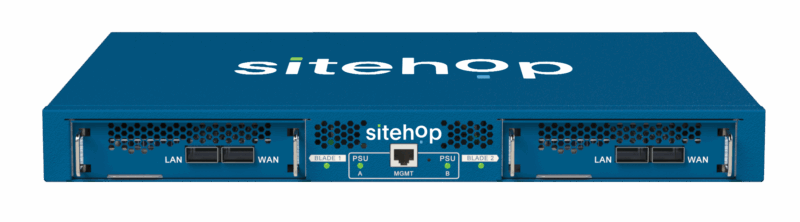
- Positioning: FPGA‑powered IPsec aggregator offering sub‑microsecond latency, 8,000 tunnels and 200 Gb/s full duplex (per 1U) and optional ML‑KEM + RFC 9370 support.
- Key advantages: Deterministic latency under load; crypto‑agile updates; compact 1U form factor; ideal for high‑fan‑in IPsec aggregation.
- Deployment: Offload encryption in the core/backhaul while using existing gateways/NGFWs for policy and application control.
Fortinet FortiGate (FortiOS 7.6+): Flexible NGFW with PQC & QKD
- Positioning: Widely deployed NGFW/SD‑WAN platform with built‑in quantum‑safe features.
- Key features: IPsec key exchange now supports NIST‑approved ML‑KEM‑512/768/1024 docs.fortinet.com; FortiOS allows stacking multiple KEMs to create hybrid keys and includes UI/CLI controls for additional key exchanges docs.fortinet.com.
- QKD readiness: Fortinet introduced QKD integration starting with FortiOS 7.4; the platform works with leading QKD vendors to provide quantum‑generated keys thefastmode.com.
- Use case: Good for edge/regional deployments needing policy inspection and multiple PQC on‑ramps (e.g., RFC 8784 mixing, ML‑KEM hybrid).
Palo Alto Networks PAN‑OS 11.2: Multi‑KEM IKEv2 and NGFW features
- Positioning: NGFW with advanced VPN controls enabling hybrid key exchange.
- Key features: Uses RFC 9242 and RFC 9370 to perform multiple successive key exchanges; by combining classical (EC)DH with one or more post‑quantum KEMs, the shared key remains secure if any algorithm holds.
- Flexibility: Administrators can specify up to seven additional KEMs and optionally mix in RFC 8784 pre‑shared keys; ideal for phased migration.
- Considerations: Provides deep policy and threat‑inspection capabilities but may introduce higher latency compared with purpose‑built hardware accelerators.
Juniper SRX/vSRX (Junos 22.4R1+): QKD integration & quantum‑safe IPsec
- Positioning: Carrier‑class firewall platform with IPsec, MACsec and QKD capabilities.
- Quantum key manager: Junos Key Manager supports quantum key manager profiles; these profiles access QKD devices to generate fresh quantum keys for each connection and use them as post‑quantum pre‑shared keys.
PPK mixing & QKD: Static key profiles can be used to inject post‑quantum pre‑shared keys (RFC 8784), while dynamic profiles fetch keys from QKD devices; QKD uses quantum channels to generate identical keys and protect both data and control planes. - Real‑world validation: A 2025 proof‑of‑concept with Turkcell, Juniper and ID Quantique demonstrated that integrating QKD with Juniper’s MACsec/IPsec frameworks protected mobile backhaul without performance loss.
- Use case: Suitable for operators seeking QKD‑ready solutions and strong service‑chain functions (firewall, NAT, QoS) alongside PQC.
Nokia IPsec Security Gateway: Carrier‑grade scale with integrated PKI
- Positioning: Runs on the 7750 SR platform with tight integration into 3GPP PKI flows via the NetGuard Certificate Manager.
- Capacity & throughput: Each line card can support 20Gb/s full duplex encryption at large packet sizes. By combining this with 16 slots a total of 320 Gb/s can be achieved in 17U.
- Considerations: Ideal for operators standardized on Nokia routers; Quantum protect provided through ANYsec
Choosing the right solution for your network
Key differences
- Latency vs features: SAFEcore = deterministic sub-µs latency; NGFWs = richer L7 features but higher/variable latency.
- Hardware vs software: Hardware offload for line-rate crypto; NGFWs are flexible but become the bottleneck at scale, as all encrypted traffic goes through software even when offload ASICs are used.
- Throughput density vs cost/power: Purpose-built aggregators pack far more encryption density per RU; NGFW capacity scales with SKU/licence/RU/power.
- QKD readiness: Plan QKD only on crown-jewel links; use standards-based hybrid IKEv2 elsewhere.
Quick compare
Conclusion & next steps
Regulators such as CISA, NSA and NIST stress that a successful PQC migration “will take time to plan and conduct” and urge organisations to begin developing quantum‑readiness roadmaps cisa.gov.
History shows that changing cryptography at scale takes longer than seven to ten years, meaning organisations that wait risk running out of time. For 5G operators, this means inventorying every protocol, device and service that uses public‑key encryption, prioritising those protecting long‑lived secrets, and working with equipment suppliers on crypto‑agility – the ability to swap algorithms quickly, techtarget.com.
CISA recommends starting with a cryptographic inventory and engaging vendors to identify technologies that must migrate to PQC cisa.gov. At the same time, engineers should begin testing NIST’s standardised PQC algorithms for key encapsulation and digital signatures and consider hybrid deployments that combine classical and quantum‑resistant methods.
By acting now, telecom and 5G providers can avoid a last‑minute scramble and ensure that future quantum breakthroughs do not undermine the trust and resilience of their networks. As HSBC noted in recent podcasts, “if you think security is expensive, have a breach” – the cost of inaction could be far greater than the investment needed to become quantum‑ready.
Secure, Scalable, and Sovereign: What Sitehop’s BT Trial Means for UK Telecoms
September 11, 2025 | BT, Latency, Post Quantum Cryptography, Sovereign Tech
Cybersecurity is at a turning point. As the quantum age approaches, today’s encryption will not hold up against tomorrow’s attacks. Techniques like ‘harvest now, decrypt later’ are already in play, and the risk is growing for telecom operators, large enterprises and public infrastructure.
That’s why Sitehop teamed up with BT to run a breakthrough trial at one of the most advanced telecoms testing grounds in Europe.
A UK-first for quantum-safe encryption
BT granted Sitehop the first-ever external access to its flagship test and integration facility, a secure replica of its live network environment. This facility is normally reserved for BT’s own internal development, making the opportunity a rare and powerful endorsement of UK cybersecurity innovation.
“Supporting SMEs is vital for the UK’s economic growth and innovation,” said Peter Bell, Managing Director of International Business and Adastral Park at BT.
“As a national champion for the UK, a key mission for BT is to help our customers build stronger, smarter, more secure businesses. An important part of this is helping innovative domestic companies to enter the market, to support supply chain sovereignty and help businesses to grow.”
What we tested and what we proved
Our goal was to show that encryption built for a quantum-safe future doesn’t have to come at the cost of speed or scale. The results were clear:
- 90Gbps throughput
- 75% reduction in power consumption
- Minimal packet loss and improved latency
- Just two clicks to configure and deploy
This was a full proof of concept in a real-world environment. The trial proved that our SAFE Series hardware can run high-speed encryption with near-zero impact on performance, even in demanding telecom conditions.
“With the right support or partnerships and commercial models,” Peter Bell continued, “we see there is potential for BT’s test and integration facilities to serve as a ‘UK PLC’ test facility that accelerates mission-led, high Technology Readiness Level innovations, contributing to a sovereign and secure UK telecoms sector.”
Why it matters now
The UK Government has named quantum one of its six ‘frontier technologies’ for long-term economic growth. To build a quantum-enabled economy, we need telecom infrastructure that is not only fast and resilient, but quantum-secure by design.
“This is a big moment that validates UK sovereign innovation can play a central role in the country’s digital infrastructure,” said Melissa Chambers, founder and CEO of Sitehop.
“We’re proving networks don’t have to sacrifice performance for security.”
Our solution is already live with a Tier 1 carrier across seven countries. It’s based on open IPsec protocols to avoid vendor lock-in and built with crypto agility, meaning firmware can be upgraded remotely as standards evolve.
Safe To Connect
Following the successful trial, BT has granted Sitehop its Safe to Connect certification, a recognition designed to help UK companies prove their technologies are robust enough for live telecom environments. This certification is more than a badge. It acts as a trust signal to operators, enterprises and government buyers that Sitehop’s technology meets the security, performance and integration standards expected in critical national infrastructure. It also marks an important step toward lowering the barriers that often keep innovative smaller companies out of telecom supply chains.
Moving forward together
BT’s collaboration with Sitehop is a signal to the broader ecosystem: it is possible for large and small players to work together to secure the UK’s national digital backbone.
“The initiative reflects BT’s ambition to strengthen the UK’s digital backbone by supporting domestic innovators and lowering barriers to market entry for small businesses,” said BT.
“It exemplifies how large and small/medium organisations can collaborate to protect the country’s national infrastructure and accelerate the UK’s quantum-enabled economy.”
To find out more, email info@sitehop.com
Or call us on: +44 (0)114 478 2366
Sitehop.
Engineered for speed. Built for the future.

Sitehop x AMD and the Next Generation of Encryption.
May 22, 2025 | AI, Post Quantum Cryptography, Security
As AI, hybrid cloud, and real-time data pipelines push network speeds to new heights, one thing is clear: security must keep up.
Traditional, software-based encryption methods are hitting their limits. They add latency, consume too much power, and create bottlenecks in performance-critical environments like data centers, telecom networks, and financial services. The future of secure connectivity demands a new architecture, engineered for speed, scalability, and crypto-agility.
The future demands the power and speed of a Sitehop and AMD partnership.
In our latest case study, we show how integrating the AMD Network Acceleration and Sitehop’s SAFEcore™ platform delivers a step change in encryption performance, without the compromises that legacy solutions face.
A Partnership Built for Speed and Security
At Sitehop, our mission is clear: deliver the world’s fastest, most efficient, post-quantum-ready encryption for data in motion.
AMD’s Network Accelerator was the perfect choice. Designed for ultra-low latency, hardware acceleration, and maximum energy efficiency, it powers Sitehop’s FPGA-based SAFEcore to secure real-time, high-throughput data movement across complex networks.
The benefits are immediate:
- Sub-microsecond latency encryption: Critical for AI, cloud, and 5G data flows.
- 10x better energy efficiency: Compared to traditional CPU-bound VPNs, cutting operational costs.
- Crypto-agile and PQC-ready security: Seamless upgrades to post-quantum encryption.
- Line-rate encryption up to 100Gbps: Protecting data without slowing down networks.
Why Hardware-First Security Matters
Today, speed without security is reckless. Security without speed is irrelevant.
Software-based encryption struggles with the demands of massive data volumes, multi-cloud environments, and emerging quantum threats. At the same time, cybercriminals are using AI to automate attacks, exploiting vulnerabilities faster than ever.
Hardware-enforced encryption minimizes attack surfaces, improves resilience, and delivers deterministic, reliable performance. It is becoming the gold standard for enterprises and service providers that cannot afford to compromise.
By combining Sitehop’s SAFEcore technology with AMD’s advanced SmartNIC hardware, organizations can now secure their networks at the speed that modern operations require.
Building for the Future
This partnership is about much more than current performance. It lays the foundation for a future shaped by:
- AI-driven cyber threats
- Quantum decryption risks
- Exponential global data growth
- Edge computing and decentralization
Networks have to be built for change, for scale, and for secure performance from the core to the edge.
With Sitehop and AMD, that future is within reach.
Engineered for speed. Built for the future.
Read AMD’s full case study to discover why hardware-first encryption is the future of secure networking. Then come back to us to discover the power of Sitehop’s solution.
Call us on: +44 (0)114 478 2366
Or email info@sitehop.com

About Us
Sitehop provides faster, better, greener alternatives to the encryption options on the market today.