Shrinking the Attack Surface

How Shrinking the Attack Surface Powers a Faster, Safer Digital World

November 7, 2025 | Attack Surface, Resilience, Transformation

Read the Story

The story of cybersecurity doesn’t have to be one of fear. It can be one of confidence, of businesses, governments, and individuals moving faster because they trust the systems they use. In an era when everything from financial transactions to energy depends on connected infrastructure, the attack surface, every point where systems can be compromised, has become one of the defining measures of digital resilience.

Rethinking the Modern Attack Surface

Today’s digital ecosystems are a vast web of distributed applications, cloud services, connected devices, and global networks all exchanging data across borders and time zones. It is the data in motion between endpoints that has become the most exposed. While data at rest often resides behind firewalls or within encrypted storage, data in motion travels through routers, gateways, and public infrastructure. Each transfer creates a point of vulnerability, an opportunity for interception, manipulation, or exploitation.

The real challenge lies in how data is handled as it moves. Most VPNs and network security systems still process customer data in software before handing it off to an ASIC to accelerate certain cryptographic functions. This approach exposes the data within the software stack, where most vulnerabilities exist. By contrast, processing customer data directly within hardware, such as an FPGA or ASIC, removes that exposure entirely. It allows encryption and protection to begin at the very first point of contact, before the data ever touches an operating system or software layer, closing one of the most significant gaps in today’s digital security model.

Common weak points include:
  • Unsecured or misconfigured tunnels, where encryption isn’t applied end-to-end.
  • Software-defined networks, where shared resources expose encryption keys to potential side-channel attacks.
  • Edge and IoT devices, which transmit sensitive data without hardware protection.

Each of these represents not just a technical risk, but a business risk. When data in motion can be intercepted or altered, confidence in the entire digital supply chain erodes. The challenge isn’t simply to encrypt more, but to encrypt smarter, to build protection into the fabric of communication itself, without slowing the flow of data or business.

The Hidden Cost of Software Encryption

Software encryption has long been the default. It’s adaptable, deployable anywhere, and easily updated. But it also shares the same resources, the same memory, CPU, and operating environment, that attackers can exploit. Every software patch, every new algorithm, adds friction. The system slows down, the complexity grows, and the attack surface widens.

In the end, the protection becomes its own bottleneck. What began as a safeguard starts holding back performance, scalability, and trust.

Hardware Encryption: Security at the Speed of Life

Encryption must be part of the very fabric of technology, built into silicon, operating at line speed, invisible to users yet impenetrable to attackers. This is hardware encryption, and it represents a profound shift in how we think about both security and performance. By isolating cryptography within dedicated hardware, organisations can:

  • Eliminate software vulnerabilities from the encryption path.
  • Scale securely, maintaining performance as data volumes and key sizes grow.
  • Protect keys absolutely, safeguarding against both cyber and physical compromise.

And the impact reaches beyond data centres or enterprise networks. When encryption happens seamlessly and instantly, it touches everyone. Reducing the attack surface doesn’t just protect systems, it protects experiences. It builds a world where trust is engineered, not assumed.

Beyond Today: Quantum Threats and Crypto Agility

The next wave of change is already on the horizon. Quantum computing promises unprecedented computational power, and with it, the potential to break today’s strongest encryption. The solution is crypto agility. Hardware-based designs make this agility possible. Algorithms can be upgraded without rewriting software or redesigning infrastructure. Security evolves in step with innovation, not in reaction to it.

The Strategic Payoff: Security as a Business Accelerator

For CIOs, CISOs, and network architects, encryption done right isn’t just a technical necessity, it’s a strategic advantage.

  • Performance and protection align: systems stay secure without slowing down.
  • Compliance becomes proactive: hardware simplifies certification and governance.
  • Cost and complexity fall: fewer patches, fewer breaches, more uptime.
  • Trust becomes measurable: secure-by-design enhances brand credibility.
How Sitehop Is Leading the Change

At Sitehop, that reality is here. Our hardware-accelerated, crypto-agile solutions deliver security at the speed of life, protecting data without compromise. Because when the attack surface shrinks, possibility expands.


To find out more, email info@sitehop.com

Or call us: +44 (0)114 478 2366

Sitehop.

Engineered for speed. Built for the future.

5 Best Post‑Quantum Encryption Solutions for Telecoms & 5G

5 Best Post Quantum Encryption Solutions for Telecoms & 5G Networks

October 21, 2025 | Post Quantum Cryptography, Telco

Read the Story

The telecom and 5G networking landscape demands solutions that can keep pace with increasing data rates, operational efficiency, and emerging cybersecurity threats such as quantum computing. Traditional encryption methods, while foundational, impose significant latency and complexity, and fail to meet modern performance and futureproofing requirements.

Post-quantum cryptography (PQC) is emerging as the critical safeguard, enabling carriers to secure data in motion against both today’s attacks and tomorrow’s quantum breakthroughs. A new generation of solutions, from hardware-accelerated platforms like Sitehop’s through to other flexible software-defined approaches, are reshaping how operators think about latency, scalability, and resilience.

This article explores the leading post-quantum encryption technologies that will define the secure future of telecom and 5G infrastructure.


Why telcos/5G providers need quantum‑safe encryption now

5G networks rely heavily on public‑key cryptography for device authentication and key exchange mechanisms for encryption. This cryptography (RSA and elliptic‑curve schemes) depends on mathematical problems that are hard for classical computers to solve but could be solved quickly by a quantum computer. Experts warn that such a cryptographically relevant quantum computer (CRQC) could arrive within the decade nist.gov, yet updating cryptography across modern networks typically takes 10–20 years (nist.gov).

Unlike the Y2K bug, which had a fixed date, the arrival of quantum computers is uncertain, and the threat may materialise before many systems have been upgraded. To make matters worse, adversaries are already collecting encrypted data in the hope of decrypting it later with quantum machines – a tactic known as “harvest now, decrypt later” nist.gov.

Nation‑states are believed to be stockpiling sensitive encrypted traffic techtarget.com, so critical data exchanged on 5G networks could be compromised years down the line if providers do not start adopting post‑quantum cryptography (PQC) soon.


How we compared the top solutions

We have compared the top solutions using a range of evaluation criteria including latency, throughput, tunnel capacity, standards support (RFC 8784, 9242, 9370), crypto‑agility, integration with existing routing hardware and post quantum readiness.

Across high-speed enterprise platforms, hardware acceleration is common, vendors use ASICs, NPUs, or FPGAs to offload cryptography. The key distinction is data-path placement (where packets land first). In FPGA-first encryptors, frames enter the hardware pipeline directly, so the latency sensitive bulk crypto executes entirely in silicon with minimal queuing, delivering deterministic ultra-low latency/jitter and very low CPU load. In feature-first security gateways, even with powerful crypto ASICs, packets typically traverse classification, policy/session handling, and service frameworks before/around the IPsec engine (with controlled CPU assist for complex cases), yielding rich L4–L7 capabilities, application ID, IDS/IPS, SD-WAN, service chaining, with modestly higher and more variable latency than a pure hardware pipeline. Both approaches are valid: the former fits high-fan-in backhaul and line-rate encryption, while the latter excels at edge and service layers where policy and application context matter.


The best post‑quantum solutions for telecoms
Sitehop SAFEcore 1000: Benchmark for deterministic Post Quantum Encryption

Sitehop SAFEcore 1000

  • Positioning: FPGA‑powered IPsec aggregator offering sub‑microsecond latency, 8,000 tunnels and 200 Gb/s full duplex (per 1U) and optional ML‑KEM + RFC 9370 support.
  • Key advantages: Deterministic latency under load; crypto‑agile updates; compact 1U form factor; ideal for high‑fan‑in IPsec aggregation.
  • Deployment: Offload encryption in the core/backhaul while using existing gateways/NGFWs for policy and application control.


Fortinet FortiGate (FortiOS 7.6+): Flexible NGFW with PQC & QKD
  • Positioning: Widely deployed NGFW/SD‑WAN platform with built‑in quantum‑safe features.
  • Key features: IPsec key exchange now supports NIST‑approved ML‑KEM‑512/768/1024 docs.fortinet.com; FortiOS allows stacking multiple KEMs to create hybrid keys and includes UI/CLI controls for additional key exchanges docs.fortinet.com.
  • QKD readiness: Fortinet introduced QKD integration starting with FortiOS 7.4; the platform works with leading QKD vendors to provide quantum‑generated keys thefastmode.com.
  • Use case: Good for edge/regional deployments needing policy inspection and multiple PQC on‑ramps (e.g., RFC 8784 mixing, ML‑KEM hybrid).


Palo Alto Networks PAN‑OS 11.2: Multi‑KEM IKEv2 and NGFW features
  • Positioning: NGFW with advanced VPN controls enabling hybrid key exchange.
  • Key features: Uses RFC 9242 and RFC 9370 to perform multiple successive key exchanges; by combining classical (EC)DH with one or more post‑quantum KEMs, the shared key remains secure if any algorithm holds.
  • Flexibility: Administrators can specify up to seven additional KEMs and optionally mix in RFC 8784 pre‑shared keys; ideal for phased migration.
  • Considerations: Provides deep policy and threat‑inspection capabilities but may introduce higher latency compared with purpose‑built hardware accelerators.


Juniper SRX/vSRX (Junos 22.4R1+): QKD integration & quantum‑safe IPsec
  • Positioning: Carrier‑class firewall platform with IPsec, MACsec and QKD capabilities.
  • Quantum key manager: Junos Key Manager supports quantum key manager profiles; these profiles access QKD devices to generate fresh quantum keys for each connection and use them as post‑quantum pre‑shared keys.
    PPK mixing & QKD: Static key profiles can be used to inject post‑quantum pre‑shared keys (RFC 8784), while dynamic profiles fetch keys from QKD devices; QKD uses quantum channels to generate identical keys and protect both data and control planes.
  • Real‑world validation: A 2025 proof‑of‑concept with Turkcell, Juniper and ID Quantique demonstrated that integrating QKD with Juniper’s MACsec/IPsec frameworks protected mobile backhaul without performance loss.
  • Use case: Suitable for operators seeking QKD‑ready solutions and strong service‑chain functions (firewall, NAT, QoS) alongside PQC.


Nokia IPsec Security Gateway: Carriergrade scale with integrated PKI
  • Positioning: Runs on the 7750 SR platform with tight integration into 3GPP PKI flows via the NetGuard Certificate Manager.
  • Capacity & throughput: Each line card can support 20Gb/s full duplex encryption at large packet sizes. By combining this with 16 slots a total of 320 Gb/s can be achieved in 17U.
  • Considerations: Ideal for operators standardized on Nokia routers; Quantum protect provided through ANYsec


Choosing the right solution for your network

Key differences

  • Latency vs features: SAFEcore = deterministic sub-µs latency; NGFWs = richer L7 features but higher/variable latency.
  • Hardware vs software: Hardware offload for line-rate crypto; NGFWs are flexible but become the bottleneck at scale, as all encrypted traffic goes through software even when offload ASICs are used.
  • Throughput density vs cost/power: Purpose-built aggregators pack far more encryption density per RU; NGFW capacity scales with SKU/licence/RU/power.
  • QKD readiness: Plan QKD only on crown-jewel links; use standards-based hybrid IKEv2 elsewhere.


Quick compare

Conclusion & next steps

Regulators such as CISA, NSA and NIST stress that a successful PQC migration “will take time to plan and conduct” and urge organisations to begin developing quantum‑readiness roadmaps cisa.gov.

History shows that changing cryptography at scale takes longer than seven to ten years, meaning organisations that wait risk running out of time. For 5G operators, this means inventorying every protocol, device and service that uses public‑key encryption, prioritising those protecting long‑lived secrets, and working with equipment suppliers on crypto‑agility – the ability to swap algorithms quickly, techtarget.com.

CISA recommends starting with a cryptographic inventory and engaging vendors to identify technologies that must migrate to PQC cisa.gov. At the same time, engineers should begin testing NIST’s standardised PQC algorithms for key encapsulation and digital signatures and consider hybrid deployments that combine classical and quantum‑resistant methods.

By acting now, telecom and 5G providers can avoid a last‑minute scramble and ensure that future quantum breakthroughs do not undermine the trust and resilience of their networks. As HSBC noted in recent podcasts, “if you think security is expensive, have a breach” – the cost of inaction could be far greater than the investment needed to become quantum‑ready.

Sitehop Raises £7.5m to Future-Proof Networks Against Quantum-Powered Cyber Threats

October 9, 2025 | Encryption, Million, Security, Sovereign Tech

Read the Story

We’re proud to announce that Sitehop has raised an additional £7.5 million, led by Northern Gritstone, bringing our total funding to £13.5 million. The round also included continued support from our existing investors, Amadeus Capital Partners, Manta Ray, Mercia Ventures, and NPIF – Mercia Equity Finance, managed by Mercia as part of the first Northern Powerhouse Investment Fund (NPIF).


Building UK Sovereign Encryption for a Quantum Future

As cyberattacks grow in scale and sophistication, the risk of quantum-enabled breaches becomes more urgent. Today’s software-based encryption methods create latency and slow data transfers, a critical weakness in performance-sensitive networks.

At Sitehop, we’re solving this with our SAFEseries™ system, which performs encryption in hardware rather than software. This approach enables ultra-low latency, quantum-resilient security, and up to 90% lower energy use compared with conventional systems.

Even in the most demanding environments, like telecoms, our hardware encryption delivers high-speed performance with near-zero impact on network efficiency.


Proven and Trusted by Industry Leaders

Founded in Sheffield by Melissa Chambers (CEO) and Ben Harper (CTO), Sitehop is already working with major partners including BT.

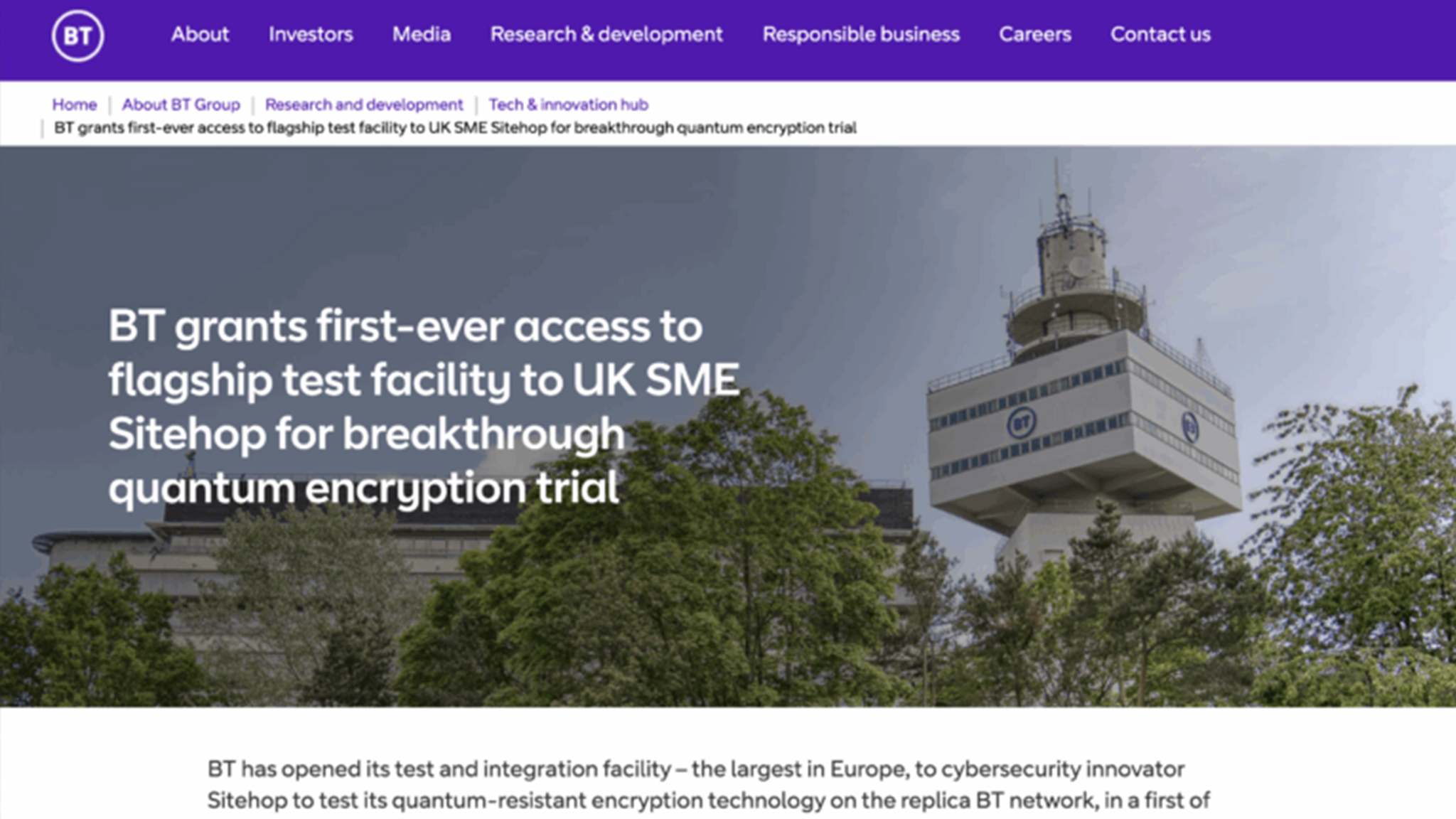
We recently completed a successful proof-of-concept trial at BT’s Gemini test facility, a replica of BT’s live network and one of Europe’s most advanced telecoms testing environments. Sitehop is also the first external company ever granted access to Gemini, a facility typically reserved for BT’s internal development teams.

Our technology is now live with a tier-one carrier across five countries, proving its scalability and reliability in real-world deployments.


Strengthening the UK’s Sovereign Capability

“Sitehop is proving the critical need for future-proof encryption, demonstrated by our early customer traction globally,” said Melissa Chambers, Co-founder and CEO. “As a Sheffield-founded company, this investment from Northern Gritstone supports our mission to grow and scale in the region and build world-leading sovereign encryption capability right here in the UK, accelerating international expansion while keeping the UK at the forefront of cybersecurity innovation.”

“Our mission has always been to deliver world-class security that is ultra-low latency, hardware-enforced, and resilient against future threats like quantum computing,” added Ben Harper, Co-founder and CTO. “Partnering with Northern Gritstone enables us to accelerate our mission while strengthening the UK’s sovereign capability in critical network security. Their ‘profit with purpose’ ethos resonates strongly with us, creating technology that drives global growth and delivers lasting social and economic value.”


Backed by Leading Deeptech Investors

Duncan Johnson, CEO, Northern Gritstone, said: “Our focus is always on ‘profit with purpose’, helping to support visionary companies with strong intellectual property to grow out of the North of England. Sitehop is an example of the incredible deep tech innovation coming out of Sheffield’s innovation cluster, providing game-changing technology to support businesses in future-proofing their cybersecurity protection. We’re delighted to be backing Melissa and Ben in an area as important as cryptography.”


Nick Kingsbury, Partner, Amadeus Capital Partners, said: “As data volumes and cyber threats grow, the need for the ultra-high throughput and low latency that Sitehop delivers means that the company is seeing strong demand from customers in many sectors. This funding gives the company the ability to deliver on that demand.”


Chris Borrett, Mercia Ventures, said: “Melissa and Ben have addressed a problem that even the biggest tech companies have failed to solve. We believe Sitehop is poised to become a major UK success story, and we are excited to partner with them on this journey.” NPIF and Mercia first invested in Sitehop in 2022.


Debbie Sorby, Senior Manager at British Business Bank, said: “Eight years on from the launch of the first Northern Powerhouse Investment Fund, we continue to see the remarkable impact businesses are making on the Northern economy. The Fund was designed to support innovative companies across the region, helping them to grow and thrive. Sitehop is a standout example of this success, now one of the UK’s leading technology businesses.”

Secure, Scalable, and Sovereign: What Sitehop’s BT Trial Means for UK Telecoms

September 11, 2025 | BT, Latency, Post Quantum Cryptography, Sovereign Tech

Read the Story

Cybersecurity is at a turning point. As the quantum age approaches, today’s encryption will not hold up against tomorrow’s attacks. Techniques like ‘harvest now, decrypt later’ are already in play, and the risk is growing for telecom operators, large enterprises and public infrastructure.

That’s why Sitehop teamed up with BT to run a breakthrough trial at one of the most advanced telecoms testing grounds in Europe.


A UK-first for quantum-safe encryption

BT granted Sitehop the first-ever external access to its flagship test and integration facility, a secure replica of its live network environment. This facility is normally reserved for BT’s own internal development, making the opportunity a rare and powerful endorsement of UK cybersecurity innovation.

“Supporting SMEs is vital for the UK’s economic growth and innovation,” said Peter Bell, Managing Director of International Business and Adastral Park at BT.

“As a national champion for the UK, a key mission for BT is to help our customers build stronger, smarter, more secure businesses. An important part of this is helping innovative domestic companies to enter the market, to support supply chain sovereignty and help businesses to grow.”

What we tested and what we proved

Our goal was to show that encryption built for a quantum-safe future doesn’t have to come at the cost of speed or scale. The results were clear:

  • 90Gbps throughput
  • 75% reduction in power consumption
  • Minimal packet loss and improved latency
  • Just two clicks to configure and deploy

This was a full proof of concept in a real-world environment. The trial proved that our SAFE Series hardware can run high-speed encryption with near-zero impact on performance, even in demanding telecom conditions.

“With the right support or partnerships and commercial models,” Peter Bell continued, “we see there is potential for BT’s test and integration facilities to serve as a ‘UK PLC’ test facility that accelerates mission-led, high Technology Readiness Level innovations, contributing to a sovereign and secure UK telecoms sector.”

Why it matters now

The UK Government has named quantum one of its six ‘frontier technologies’ for long-term economic growth. To build a quantum-enabled economy, we need telecom infrastructure that is not only fast and resilient, but quantum-secure by design.

“This is a big moment that validates UK sovereign innovation can play a central role in the country’s digital infrastructure,” said Melissa Chambers, founder and CEO of Sitehop.

“We’re proving networks don’t have to sacrifice performance for security.”

Our solution is already live with a Tier 1 carrier across seven countries. It’s based on open IPsec protocols to avoid vendor lock-in and built with crypto agility, meaning firmware can be upgraded remotely as standards evolve.

Safe To Connect

Following the successful trial, BT has granted Sitehop its Safe to Connect certification, a recognition designed to help UK companies prove their technologies are robust enough for live telecom environments. This certification is more than a badge. It acts as a trust signal to operators, enterprises and government buyers that Sitehop’s technology meets the security, performance and integration standards expected in critical national infrastructure. It also marks an important step toward lowering the barriers that often keep innovative smaller companies out of telecom supply chains.

Moving forward together

BT’s collaboration with Sitehop is a signal to the broader ecosystem: it is possible for large and small players to work together to secure the UK’s national digital backbone.

“The initiative reflects BT’s ambition to strengthen the UK’s digital backbone by supporting domestic innovators and lowering barriers to market entry for small businesses,” said BT.

“It exemplifies how large and small/medium organisations can collaborate to protect the country’s national infrastructure and accelerate the UK’s quantum-enabled economy.”


To find out more, email info@sitehop.com

Or call us on: +44 (0)114 478 2366

Sitehop.

Engineered for speed. Built for the future.

The Technology That Matters: Insights from FCS2025

August 22, 2025 | FCS2025, Performance, Security

Read the Story

The Fortinet Cybersecurity Summit 2025 (FCS2025) was more than just a showcase of cutting-edge solutions. It was a powerful reminder that in a world of constant change, it is the right technology that makes the difference.


Hosted at the Transamerica Expo Centre in São Paulo, the event brought together industry leaders, partners, and innovators to shape the future of secure digital transformation. Sitehop was honoured to be invited by NCT, our trusted local business partner in Brazil, to join and present our solutions during this important gathering.


The Big Themes


Cybersecurity must adapt as fast as threats do

The summit highlighted how AI-driven defence and adaptive infrastructure are becoming non-negotiable. Organisations that thrive will be those that choose technologies designed for resilience and rapid response.


Performance and security aren’t trade-offs anymore

For too long, businesses believed that stronger security meant sacrificing speed or efficiency. Conversations at FCS2025 challenged that idea, demonstrating how the next wave of solutions can deliver both, seamlessly.


Trust is built into the technology we choose

Beyond tools and frameworks, the event emphasised trust: trust in systems, in vendors, and in the partnerships that power them. The message was clear: organisations must align with technologies that earn and sustain that trust.


Never trust, always verify

Another recurring theme at FCS2025 was the rise of the Zero Trust security model,  which requires every access request, whether internal or external – to be continuously authenticated and monitored. By removing implicit trust, organisations can reduce the risk of insider threats and lateral attacks, while also staying resilient in an age of remote work, cloud adoption, and increasingly sophisticated cyber threats.


The Technology That Matters: What to Explore Next

FCS2025 wasn’t just about today’s challenges. It was about sparking reflection on tomorrow’s priorities. As you consider your own roadmap, here are some of the technology dimensions that matter most:


Hardware acceleration for real-world performance

The ability to handle encrypted traffic at scale, without bottlenecks, is now business-critical. Exploring hardware-accelerated solutions can unlock both efficiency and security at levels that traditional software approaches simply cannot match.


Energy-conscious innovation

With sustainability now at the core of enterprise strategy, the way your security and networking infrastructure consumes energy is no longer a side note. Low-power, high-efficiency technology is shaping a new standard, delivering performance that is also environmentally responsible.


Simplicity in a complex world

As infrastructures grow, simplicity becomes a strategic advantage. Solutions that integrate smoothly, reduce overhead, and streamline deployment free your teams to focus on what matters: enabling growth, not firefighting.


Looking Forward

The conversations at FCS2025 made it clear: the future belongs to organisations that adopt The Technology That Matters. That means performance without compromise, security that scales, efficiency that is sustainable, and simplicity that empowers.


As cybersecurity continues to evolve, the challenge isn’t just to keep pace. It is to choose the technologies that set you ahead.


And perhaps most importantly, it is about being willing to think differently. Today’s challenges demand a fresh lens: exploring new vendors, re-imagining how technologies combine, and building stacks that are fit for an era defined by high-speed data in motion, ultra-low latency, and uncompromising encryption. Looking ahead, the looming risks of quantum computing remind us that tomorrow’s threats will require not just stronger defences, but smarter, more adaptive approaches. The organisations that start rethinking now will be the ones ready for whatever comes next.


To find out more, email info@sitehop.com

Or call us on: +44 (0)114 478 2366


Sitehop.

Engineered for speed. Built for the future.

The Silent Killer of Secure Digital Experiences

August 8, 2025 | Encryption, Mobile Networks, Telco

Read the Story

Why Secure Network Performance Defines Customer Loyalty

The modern digital economy runs on trust. Whether you’re streaming an encrypted video call or executing high-value transactions, the expectation is simple: fast, seamless, and secure connectivity, all at once. But behind the scenes, telcos are often wrestling with an invisible enemy, the performance trade-offs introduced by encryption.


When Encryption Becomes a Bottleneck

As mobile data volumes surge, end-to-end encryption protocols like IPsec have become non-negotiable. They’re the backbone of privacy, compliance, and cyber resilience for telcos and their customers. But encrypting every packet of data takes a heavy toll on legacy security gateways. These older systems struggle to process high volumes of small packets, the kind that dominate real-time traffic like Zoom calls, VoIP, and financial transactions. The result?

  • Packet loss, leading to frozen video streams and dropped calls
  • Latency spikes, which cause time-sensitive applications to stutter or fail
  • Jitter and retransmissions, degrading user experiences and increasing operational costs

For enterprises and consumers alike, these issues are more than technical nuisances. They erode confidence and trust in a brand. A single failed video pitch, delayed payment, or slow market trading insight can be the difference between success and failure.


The Loyalty Factor

In today’s always-on world, secure network performance is a customer loyalty and business growth driver. A recent shift in business and consumer behaviour shows that connectivity issues, especially on encrypted services, are among the top reasons for switching providers. People are highly intolerant of downtime or lag, particularly when sensitive data is at stake.

Telcos now face a simple but daunting equation, can they deliver high-speed, low-latency services without compromising on encryption strength? Those that can’t, will see customers migrate to competitors that can.


A Call to Modernize

The pressure is on telcos to overhaul their mobile-to-fixed network edge. Modern, high-throughput solutions are capable of handling encryption at speed, ensuring:

  • Zero compromise on data security
  • Consistent performance for real-time apps
  • Smoother digital experiences that build trust


The outcome?  Video calls that don’t stutter, transactions that complete instantly, and information at someone’s fingertips at high speed. For businesses, it means operational resilience and fewer headaches. For telcos, it means retaining customers in an era where loyalty is earned by securing performance, not just providing it.

To find out more, request our Telco focused white paper: info@sitehop.com

Sitehop. Engineered for speed.
Built for the future.

Or call us on: +44 (0)114 478 2366


Build. Connect. Accelerate: BT, Sitehop, and the future of UK digital infrastructure.

July 7, 2025 | Adastral Park, BT, Gemini, R&D, Security, Telco

Read the Story

With the explosion of data, increased risk, and customers demanding trusted high-speed communications, there’s never been a better time to evolve the networks the UK needs. Secure, fast, future-proof and trusted. That’s why we’re proud to announce Sitehop’s involvement in a first-of-its-kind Proof of Concept (PoC) with BT at the Gemini test facility within Adastral Park, home to BT’s global R&D.

This collaboration represents more than a technical validation. It signals a shift, a growing belief that agile, sovereign innovators have a critical role to play in securing and accelerating the UK’s digital infrastructure with a foundation of engineering and innovation. Keeping people connected. At speed. Safely.


A New Model for Collaboration

The Gemini facility is a replica of BT’s live network, Europe’s largest and most advanced telecom test environment. Until now, access to Gemini has been limited to BT and its tier-one vendors. This week, Sitehop is the first SME to be invited in. Our mission is to demonstrate how our high-speed, low-power, post-quantum-ready encryption hardware and Network Management can meet BT’s performance, interoperability and security standards, and potentially qualify for Safe to Connect certification, BT’s highest trust benchmark.

For both sides, this trial is about more than devices. It is about testing an approach for the future where the UK’s network leaders and security innovators work together to create the kind of infrastructure the country, and the world, needs.


Built to Support BT’s Transformation

BT has made clear its strategic intent:

  • To build the best, most trusted digital networks
  • To connect customers so they thrive, as we grow, in a digital world.
  • To accelerate modernisation to restore leadership in everything BT does

At Sitehop, our technology has been engineered to do exactly that.

Build: We remove legacy bottlenecks with ultra-low latency, FPGA-based encryption, delivering 100 Gbps performance with crypto agility built in.

Connect: Our plug-and-play devices support scalable deployments from the core to the edge, without sacrificing simplicity or cost-efficiency.

Accelerate: We enable faster, greener, more secure network growth. Sitehop uses just a tenth of the power of traditional solutions while delivering 10,000x lower latency than software-based alternatives.

These are not incremental improvements. They are exponential gains, the kind that can help us unlock the next generation of UK connectivity.


Why Telcos Choose Sitehop

Telecom networks are evolving rapidly, becoming more dynamic and security critical. Sitehop enables operators to keep pace and stay ahead.

  • Zero trade-offs: Add robust, real-time encryption without sacrificing network performance, customer experience or cost efficiency.
  • End-to-end flexibility: From 1 Gbps to 100 Gbps, classical encryption to post-quantum cryptography, Sitehop scales to fit any architecture.
  • Easy to deploy and manage: Pre-integrated with existing network infrastructure, with cloud-ready, centralised management through Sitehop SAFEnms.
  • Future-proof by design: Post-quantum ready, crypto agile, and engineered to support the demands of AI, 5G, edge and hyperscaler environments.
  • Sustainable and efficient: A fraction of the energy consumption of software-based solutions, helping operators hit sustainability targets while boosting performance.
  • Trusted and sovereign: Built entirely in the UK, Sitehop helps reduce supplier dependency while strengthening national and commercial security posture.

For telcos, this is a smarter way to secure networks.


Supporting a Stronger UK Ecosystem

Sitehop is a UK-born, UK-backed business with global vision. But our mission starts here, protecting the nation’s networks and data at the speed modern business, and we as consumers demand.

This Proof of Concept reflects a broader opportunity, to create space for mission-led, sovereign innovators within national infrastructure to give the UK a more competitive, more resilient and more sustainable digital foundation.

We are proud to be the first company to take part in this type of PoC. But we are even more excited about what happens next.


The Future Is Now

As BT says in its 2025 Strategic Report – the world is getting louder, faster and more complex. Networks are evolving. Threats are multiplying. Expectations are rising. And the UK has the chance to lead, by building trusted digital infrastructure backed by trusted innovation. That’s exactly where Sitehop thrives.

Sitehop. Engineered for speed. Built for the future.

Call us on: +44 (0)114 478 2366

Or email info@sitehop.com

Categories: BT, Infrastructure, Security

Sitehop x AMD and the Next Generation of Encryption.

May 22, 2025 | AI, Post Quantum Cryptography, Security

Read the Story

As AI, hybrid cloud, and real-time data pipelines push network speeds to new heights, one thing is clear: security must keep up.


Traditional, software-based encryption methods are hitting their limits. They add latency, consume too much power, and create bottlenecks in performance-critical environments like data centers, telecom networks, and financial services. The future of secure connectivity demands a new architecture, engineered for speed, scalability, and crypto-agility.


The future demands the power and speed of a Sitehop and AMD partnership.

In our latest case study, we show how integrating the AMD Network Acceleration and Sitehop’s SAFEcore™ platform delivers a step change in encryption performance, without the compromises that legacy solutions face.


A Partnership Built for Speed and Security

At Sitehop, our mission is clear: deliver the world’s fastest, most efficient, post-quantum-ready encryption for data in motion.


AMD’s Network Accelerator was the perfect choice. Designed for ultra-low latency, hardware acceleration, and maximum energy efficiency, it powers Sitehop’s FPGA-based SAFEcore to secure real-time, high-throughput data movement across complex networks.


The benefits are immediate:
  • Sub-microsecond latency encryption: Critical for AI, cloud, and 5G data flows.
  • 10x better energy efficiency: Compared to traditional CPU-bound VPNs, cutting operational costs.
  • Crypto-agile and PQC-ready security: Seamless upgrades to post-quantum encryption.
  • Line-rate encryption up to 100Gbps: Protecting data without slowing down networks.


Why Hardware-First Security Matters

Today, speed without security is reckless. Security without speed is irrelevant.


Software-based encryption struggles with the demands of massive data volumes, multi-cloud environments, and emerging quantum threats. At the same time, cybercriminals are using AI to automate attacks, exploiting vulnerabilities faster than ever.


Hardware-enforced encryption minimizes attack surfaces, improves resilience, and delivers deterministic, reliable performance. It is becoming the gold standard for enterprises and service providers that cannot afford to compromise.


By combining Sitehop’s SAFEcore technology with AMD’s advanced SmartNIC hardware, organizations can now secure their networks at the speed that modern operations require.


Building for the Future

This partnership is about much more than current performance. It lays the foundation for a future shaped by:

  • AI-driven cyber threats
  • Quantum decryption risks
  • Exponential global data growth
  • Edge computing and decentralization


Networks have to be built for change, for scale, and for secure performance from the core to the edge.


With Sitehop and AMD, that future is within reach.

Engineered for speed. Built for the future.


Read AMD’s full case study to discover why hardware-first encryption is the future of secure networking. Then come back to us to discover the power of Sitehop’s solution.


Call us on: +44 (0)114 478 2366

Or email info@sitehop.com

The AI Data Boom and the Encryption Dilemma: Why the Future of Networks Hangs in the Balance

May 15, 2025 | AI, Encryption

Read the Story

Data is moving faster and in greater volumes than ever before, and the demands on network infrastructure are at an all-time high. AI is fuelling an explosion of data, while cyber threats grow more sophisticated by the day.


By 2025, global data creation is expected to reach 181 zettabytes, up from just 64.2 zettabytes in 2020 (IDC). With AI-driven traffic growing at a staggering rate, AI workloads alone will account for a significant share. Meanwhile, cyber threats continue to escalate, with ransomware attacks increasing and quantum computing threats fast approaching.


The problem? The very encryption designed to protect this data is now slowing networks down.


Four Trends Reshaping Network Speed & Security
  1. AI’s Data Surge – AI models need to process enormous datasets in real time, putting unprecedented pressure on networks, so without high-speed, high-security infrastructure, AI-driven services will struggle with delays, bottlenecks, and security vulnerabilities.
  2. Rising Global Cyber Threats – Ransomware, state-sponsored attacks, and cyber espionage are more sophisticated than ever, which means stronger encryption is crucial to safeguarding sensitive data, but traditional methods can slow down network performance.
  3. The Race to Quantum-Safe Security – Quantum computing will render many encryption standards obsolete, requiring new cryptographic approaches. Organizations that don’t prepare now risk being exposed to “harvest now, decrypt later” attacks, where encrypted data is stolen today and cracked once quantum technology matures.
  4. Demand for Low-Latency Applications – Real-time financial transactions, 5G networks, and remote collaboration all require sub-millisecond latency. Legacy encryption solutions add too much processing overhead, making them unsuitable for modern low-latency use cases.


The Trade-Off Nobody Talks About

Right now, many network operators, cloud providers, and data centres are being forced to choose between encryption and speed. The more robust the encryption, the slower the network. To maintain throughput, security risks being dialled back, exposing critical data in motion to risk.


Key problems and solutions
  1. AI-driven data growth is pushing networks to their limits.
    Invest in high-performance infrastructure that can scale with AI-driven demands. Harness advanced encryption solutions designed to keep up with the demands of high-speed, high-volume data transmission.
  1. Encryption is slowing networks down, forcing compromises on security.
    Stop choosing between speed and security, demand solutions that deliver both.
    Plan for hardware-based encryption that secures data in motion without impacting network performance.
  1. The post-quantum era will demand even more computing power.
    Start PQC migration planning now to future-proof your network. PQC-ready encryption that ensures long-term security without disrupting existing infrastructure.
  2. Speed and security must go hand in hand, not compete.
    Prioritize solutions that eliminate trade-offs, rather than accepting performance losses. Engage partners with purpose-built encryption technology that accelerates security without adding latency.
  3. Hardware-first encryption is the only way to achieve both.
    It’s time to move away from software-based encryption that slows data transmission down. Dedicated encryption hardware that delivers scalable, high-speed protection for evolving network demands is a must have.


The Future of Network Security Starts Now

The AI-driven data explosion, rising cyber risks, and PQC demands aren’t future problems, they’re here today. Don’t let security be the bottleneck that holds your business back. With the right encryption approach, you can secure your network at speed. Are you ready?


Sitehop. Engineered for speed. Built for the future.

Cyber Essentials

May 7, 2025 | Uncategorized

Read the Story

Sitehop Achieves Cyber Essentials Certification

Sitehop is proud to announce that we are now officially Cyber Essentials Certified, a government-backed recognition that validates our commitment to protecting organisations against the most common cyber threats.

In an age where resilience and trust are non-negotiable, Cyber Essentials is more than a badge. It is a signal that Sitehop’s internal processes, systems, and products meet a robust baseline of security standards set by the UK National Cyber Security Centre (NCSC). This matters not only to our customers, but to every partner relying on next-generation encryption that is secure, scalable, and future-ready.


Why Cyber Essentials Matters

Cyber Essentials is critical for any business working with public sector organisations or critical national infrastructure. For Sitehop, this certification reinforces our alignment with UK government cybersecurity standards, especially as we continue to work with clients across defence, government, telecoms, and enterprise networks.


It also further validates the integrity of Sitehop and our SAFE Series, built to deliver ultra-secure, low-latency, crypto-agile encryption that protects data in motion, even in post-quantum environments.


Building Trust Across Government

Government agencies today require encryption that is engineered for long-term resilience, scalable deployments, and compliance with the evolving threat landscape. Whether it is national defence, public services, or cross-border communication, Sitehop’s approach has always been engineered for trust.


Now with Cyber Essentials certification, our capability to deliver trusted security solutions is formally recognised. Find out more about Sitehop’s approach to government and critical infrastructure here.


See Us at CyberUK

Sitehop will be exhibiting at CyberUK 2025 (Stand F13, Manchester Central, 6 to 8 May), the UK’s flagship cybersecurity event hosted by the NCSC. Join us there to see our latest SAFE Series demos and discover why Sitehop is the perfect partner for the new era of network security.


Future-proof your encryption, maximize performance, and stay ahead of tomorrow’s cyber threats—today. Talk to us about deploying the SAFE Series in your network.


Sitehop. Engineered for resilience. Built for the future.

Call us on: +44 (0)114 478 2366

Or email info@sitehop.com