
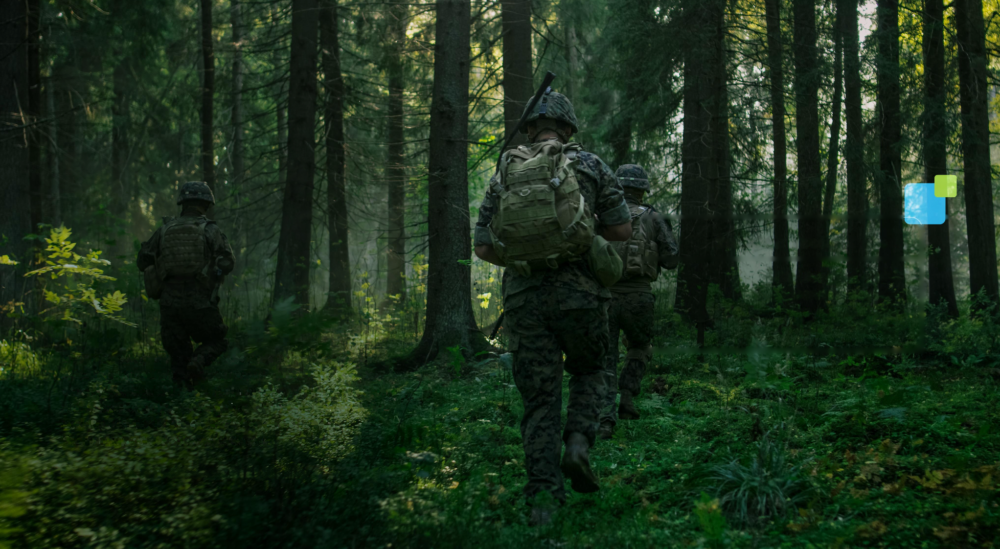
Before the Mission Advances, the Data Moves
A modern military mission doesn’t begin when troops deploy, a ship leaves port or an aircraft takes off.
It begins when data starts moving.
Mission plans, intelligence, sensor feeds, logistics, communications and command decisions all travel across networks long before people or platforms move into position. If that data is delayed, exposed or compromised, the mission is already at risk.
For decades, defence organisations have invested heavily in protecting physical assets. Yet many of the networks connecting those assets still rely on infrastructure designed years, sometimes decades, ago. Replacing those systems isn’t practical and, in many cases, isn’t even possible.
The challenge facing defence today is no longer simply how to build the next generation of secure networks. It is how to secure the networks already carrying today’s missions.
Legacy isn’t the problem. Leaving it exposed is.
Defence has always been different from the commercial world.
Platforms remain operational for decades. Radar systems, communications equipment, naval platforms, vehicles and industrial control systems frequently outlive several generations of IT. They continue performing critical roles long after the software around them has evolved. Replacing those systems simply because cryptography has changed isn’t financially or operationally realistic.
Instead, organisations face a far more pressing question: how do you protect long-life assets without redesigning everything around them?
And just because legacy platforms can stay in place doesn’t mean the threat is standing still with them. Modern warfare is evolving quickly: contested and denied spectrum, autonomous systems, and adversaries who go after the weakest link in a network rather than the newest one. Protecting what’s already in the field is only half the challenge. Defence also needs new, innovative approaches, delivered by companies built to move at the pace the threat now demands, not the multi-year timelines legacy suppliers were designed around.
As post-quantum cryptography (PQC) becomes a national priority, many are beginning to recognise that the answer lies in securing what already exists, rather than replacing it. One increasingly attractive approach is to create a cryptographic overlay around legacy equipment, surrounding trusted systems with modern protection while leaving proven operational behaviour untouched. Applications continue working exactly as before; only the security surrounding them changes. That emerging approach formed a central theme of our recent defence strategy discussion.
Performance is operational assurance
Security has traditionally been viewed as a compromise. Stronger encryption often meant more latency, lower throughput or changes to application behaviour.
In defence, those compromises simply aren’t acceptable.
Whether protecting a radar system, command network or autonomous platform, operators need confidence that introducing stronger security will not alter timing, packet flow or system performance.
The goal isn’t simply faster encryption. It’s deterministic performance, where security becomes effectively invisible to the application. Networks behave exactly as they always have, only with stronger protection around every packet.
When engineers can introduce modern cryptography without changing how systems communicate, upgrading security becomes significantly less disruptive.
Why hardware matters
Most modern security platforms rely heavily on software, delivering flexibility but also increasing complexity. Every operating system, software library and management layer expands the potential attack surface.
Hardware-enforced security takes a fundamentally different approach.
Rather than processing sensitive traffic through multiple software layers, cryptographic operations are isolated inside dedicated hardware, while management functions remain separate from customer data. The result is a smaller attack surface, clearly defined cryptographic boundaries and an architecture that is easier to audit and trust. During our discussion, this separation between management, configuration and data planes emerged as one of the key differentiators for high-assurance environments.
For defence organisations, that physical separation provides something increasingly valuable: certainty. Security teams know exactly where encryption begins, what protects it and where the cryptographic boundary sits.
Commercial innovation is strengthening national security
Some of the most valuable innovation now entering defence has been refined elsewhere.
Global telecommunications providers have spent years solving problems around resilience, availability, segmentation and operating secure networks at enormous scale. Those lessons translate remarkably well into national security environments.
Capabilities originally designed to isolate customers across multinational telecoms networks can also isolate users, systems and operational domains within defence. Instead of flat architectures where compromise can spread laterally, organisations can build segmented environments that reduce blast radius and contain attacks far more effectively.
The technology may have matured in commercial networks, but its operational value is increasingly being recognised in defence.
Modernisation doesn’t always mean replacement
Quantum computing, AI-assisted cyber attacks and increasingly sophisticated nation-state threats are accelerating the need to modernise security. Yet modernisation should not automatically be confused with replacement.
For organisations responsible for defence, government and critical national infrastructure, the most practical path forward is often to retain trusted platforms, preserve operational workflows and simply modernise the protection surrounding them.
That approach avoids costly infrastructure refresh programmes while enabling organisations to strengthen security today rather than waiting years for complete system replacement.
Before the mission moves…
Every mission depends on trust.
Trust that systems behave predictably. Trust that information arrives intact. Trust that communications remain confidential. Long before a vehicle moves, before a sensor reports or before a commander makes a decision, data is already travelling across the network. Protecting that journey is rapidly becoming one of the defining cybersecurity challenges of the next decade. Because in modern defence, the first thing that moves is rarely the mission itself.
It’s the data.
For organisations looking to strengthen security without replacing the infrastructure they depend on, Sitehop’s SAFE Series™ provides a hardware-enforced cryptographic overlay designed for mission-critical networks. Spanning core, edge and centralised management, the platform delivers deterministic, ultra-low-latency encryption, physical network segmentation and post-quantum cryptographic agility, enabling defence, government and critical infrastructure organisations to protect legacy and modern systems alike while preserving the performance and resilience their missions demand.
Read the full PQC Migration Readiness Guide and explore more at sitehop.com
Book a Sitehop demo to see how end-to-end encryption keeps data safe.
Or call us: +44 (0)114 478 2366
Sitehop.
Sitehop. Engineered for resilience. Built for the life.


About Us
Sitehop provides faster, better, greener alternatives to the encryption options on the market today.